
Consultation
+91 97731 50167
Maternity Benefits Act Compliance
in Mumbai - Complete Guide
Let’s be honest—maternity benefit compliance can seem overwhelming. But here’s the thing: it’s not just about ticking boxes and avoiding penalties. It’s about supporting your women employees during one of the most important phases of their lives. And when you get it right, everyone wins.
The Maternity Benefit Act was given a major upgrade in 2017. India now offers one of the most generous maternity leave policies globally—26 weeks for most employees. That’s pretty impressive! But with great benefits come greater compliance responsibilities. Don’t worry, though, we’re going to break this down into simple, manageable steps, explained by a Maternity Benefits Act Compliance in Mumbai.

Who Needs to Comply? Maternity Benefits Act
Your establishment needs to follow this Act if:
- You employ 10 or more people in Mumbai
- You have women employees (even one!)
- You operate any kind of business—shop, factory, office, restaurant, you name it
Which employees are covered?
- Any woman who has worked for at least 80 days in the past 12 months
- Permanent, temporary, or contract employees—all qualify
- Full-time and part-time workers (if they meet the 80-day rule)
Maternity Benefits Act Compliance in Mumbai
Steps for Compliance with Maternity Benefits Act
Step 1: Get Your Registration Right
Before anything else, your Mumbai establishment needs to be registered with the Maharashtra labor department. Think of this as your compliance foundation.
What you'll need:
- Business registration documents
- PAN card
- Address proof of your office
- Employee list with basic details
- Bank account information
- Authorized person's details
Pro tip: Start this process early. It can take a few weeks, and you don't want to be caught off-guard when an employee announces her pregnancy.
Step 2: Display the Act (Yes, Really!)
You need to put up an abstract of the Maternity Benefit Act where everyone can see it. This isn't bureaucratic nonsense—it's how your employees learn their rights.
Important: The display should be in English AND Marathi. You can download the official version from the labor department website.
Bonus points: Include this information in your employee handbook and company intranet. Make it easy for people to find.
Step 3: Maintain the Right Records
Here's where many Mumbai businesses trip up. You need to maintain specific registers, and they need to be accurate.
Must-have registers:
- Attendance Register: Daily attendance for all employees. This proves the 80-day eligibility.
- Maternity Benefit Register: Details of every woman who takes maternity leave—names, dates, amounts paid, the works.
- Wage Register: Clear records of salaries paid, including all components.
Keep these records for at least 3-5 years. Trust us, during inspections or disputes, these registers are your best friends.
Step 4: Calculate Benefits Correctly
This is crucial. Get the math wrong, and you'll either shortchange your employee or overpay unnecessarily.
Here's the formula:
- Take the woman's total wages for the 3 months before she gives her maternity notice
- Divide by the number of days she actually worked during those months
- That's her daily wage rate for maternity benefits
Example: Employee gives notice in January, planning leave from March. You calculate using October, November, December wages. If she earned ₹90,000 over 60 working days, her daily rate is ₹1,500.
Step 5: Process Leave Applications Smoothly
When an employee applies for maternity leave, you need a clear process.
What the employee should submit:
- Written application (at least 6 weeks before expected delivery)
- Expected delivery date
- Desired leave start date
- Doctor's letter or prescription
What you should do:
- Acknowledge receipt immediately
- Confirm the approved dates
- Specify the benefit amount she'll receive
- Outline the payment schedule
Be kind and prompt. This is a stressful time for your employee. Clear, quick responses make a huge difference.
Step 6: Know the Leave Entitlements
The 2017 amendment made things more generous but also more complex.
26 weeks of paid leave:
- For women having their first or second child
- Can take up to 8 weeks before delivery
- Remaining weeks after delivery
12 weeks of paid leave:
- For women who already have two or more children
- 6 weeks before and 6 weeks after delivery
12 weeks for adoption/surrogacy:
- From the date the child (under 3 months old) is handed over
6 weeks for miscarriage:
- Immediately following the miscarriage
- Medical certificate required
Step 7: Handle Payments Properly
Payment timing and accuracy are non-negotiable.
Payment rules:
- Must be paid during the leave period (not after)
- Continue regular salary cycles OR pay in installments
- Include all statutory deductions (PF, ESI, TDS)
- Transfer directly to bank account
- Keep detailed payment records
Most Mumbai companies do this: Continue regular monthly salary during maternity leave. It's simple and keeps things consistent for the employee.
Step 8: Work from Home Option
This is a game-changer introduced in 2017, but many employers don't know about it.
After the mandatory post-delivery leave, women can request to work from home for the remaining leave period—if the job permits.
Things to sort out:
- Which roles can work from home
- Performance expectations
- Communication protocols
- Equipment and technology support
This needs mutual agreement. Both employer and employee should be comfortable with the arrangement.
Step 9: Nursing Breaks Are Mandatory
Once your employee returns to work, she's entitled to nursing breaks until her child is 15 months old.
What's required:
- Two breaks per day
- 15-30 minutes each (check your state rules)
- In addition to regular breaks
- Counted as working hours (paid)
Going beyond: If you have 50+ employees, you need to provide creche facilities. Even if you're smaller, consider it—it's a huge benefit for working mothers.
Step 10: Employment Protection is Serious
You cannot—absolutely cannot—fire or dismiss a woman during her maternity leave. Period.
Protected period:
- From when she gives pregnancy notice
- Through her entire maternity leave
- Any termination during this time can land you in legal trouble
When she returns:
- Same position
- Same salary and benefits
- Same terms and conditions
Even if there are layoffs or restructuring, you need to be extremely careful. Get legal advice before making any decisions affecting women on maternity leave.
Step 11: Document Everything
In compliance, if it's not documented, it didn't happen.
Keep these safely:
- Original leave applications
- Medical certificates
- Approval letters
- Payment records with dates and amounts
- Attendance records
- Any correspondence about work-from-home
- Records of nursing breaks
- Extension requests and approvals
Digital or physical—doesn't matter. Just keep them organized and accessible for at least 5 years.
Step 12: Create Clear Internal Policies
The law sets the minimum. Your policy should make implementation easy.
Your policy should cover:
- How to apply for leave (forms, timelines)
- Approval process and timelines
- Payment schedule details
- Return-to-work procedures
- Nursing break arrangements
- Work-from-home options
- How performance reviews are handled during leave
Communicate this to everyone, not just women employees. When the whole team understands, support comes naturally.
Step 13: Be Inspection-Ready
Labour inspectors can visit anytime. Being prepared is smart business.
They'll check:
- Is the Act displayed properly?
- Are registers maintained and updated?
- Have benefits been paid correctly?
- Any complaints from employees?
If issues are found, cooperate and fix them promptly. Small mistakes caught early rarely become big problems.
Understand What Non-Compliance Costs
Let's talk consequences because they're real and they hurt.
Legal penalties:
- Up to 1 year imprisonment
- Fines up to ₹5,000
- Higher penalties for repeat offenses
Business impact:
- Reputation damage (word spreads fast)
- Difficulty attracting good talent
- Employee lawsuits (expensive and time-consuming)
- Loss of business relationships
The smart approach: Compliance isn't a cost—it's an investment in your business and your people.
Maternity Benefits Act Consultant
Common Mistakes to Avoid
❌ "She's on contract, so maternity benefits don't apply" Wrong! If she's worked 80 days in 12 months, she qualifies.
❌ "Probation employees aren't eligible" Also wrong! Probation status doesn't matter—only the 80-day rule matters.
❌ "We can't afford to give 26 weeks paid leave" It's not optional. It's the law. Plan your resources accordingly.
❌ "ESIC covers it, so we don't need to do anything" You still handle leave management and job protection, even if ESIC pays the benefits.
❌ "We'll handle the paperwork when someone gets pregnant" Too late! Systems should be ready before any employee announces pregnancy.
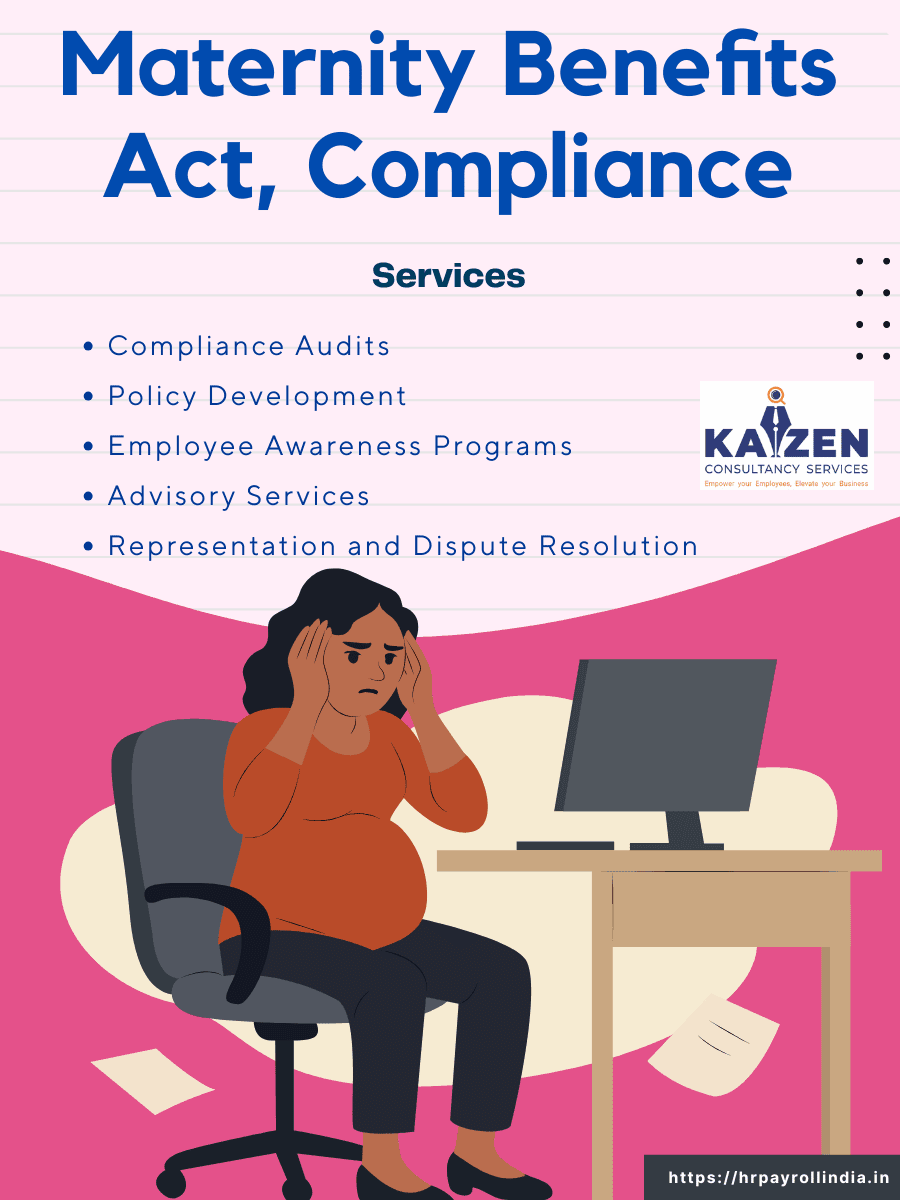
Maternity Benefits Act Compliance
Making it work for Small Businesses
If you're a small business in Mumbai, compliance might feel like a burden. Here's how to manage:
Start simple:
- Create basic templates for applications and approvals
- Use Excel sheets for maintaining registers
- Set aside budget for maternity benefits in your annual planning
- Build relationships with one or two consultants for complex situations
Maternity Benefits Act Compliance
Why Kaizen Consultancy Can Help
- We're based in Mumbai and understand local requirements
- We've helped dozens of companies—from 10-employee startups to 500+ employee corporations
- We handle the compliance headaches so you can focus on growing your business
- Our fees are transparent and reasonable
- We don't just help you comply—we help you build supportive workplace cultures
Think about it this way: Would you rather spend hours trying to decode legal documents and maintain registers, or spend that time on your core business? The cost of expert help is almost always less than the cost of getting it wrong.
Maternity Benefits Act
Ready to Get Your Maternity Benefits Compliance Sorted?
Don't wait for an employee to announce her pregnancy to start thinking about compliance. Get your systems in place now. And if you need help—whether you're starting from scratch or fixing existing gaps—we're here.
Contact Kaizen Consultancy today:
- Get a compliance assessment
- Understand exactly what you need to do
- Receive a clear quote with no hidden costs
- Start building a compliant, employee-friendly workplace
Let's make maternity benefit compliance simple, stress-free, and supportive for everyone involved.
Because at the end of the day, compliance isn't just about following rules—it's about doing right by your employees when they need it most.
Contact our expert Maternity Benefits Act Consultants – Kaizen Consultancy Services today to streamline your Maternity compliance!