
Consultation
+91 97731 50167
Maternity Benefits Under New Labour Codes
Picture this: A talented software developer on your team announces she’s pregnant. Instead of quietly worrying about career implications, she confidently plans for 26 weeks of paid leave, knowing her job is protected and she’ll return to the same position and salary. She even discusses working from home for part of her leave and asks about the nursing room facilities.
This isn’t happening in some Scandinavian country with legendary worker benefits. This is happening right now in Mumbai offices, thanks to maternity benefit provisions under the New Labour Codes that came into effect from November 2025.
For employers—whether you’re running a startup in Bandra, managing a manufacturing unit in Thane, operating a retail chain across Mumbai, or heading HR for a corporate office in BKC—understanding maternity benefits isn’t optional anymore. The provisions are comprehensive, the penalties for non-compliance are severe, and more importantly, how you handle maternity benefits directly impacts your ability to attract and retain talented women employees.
This comprehensive guide walks you through everything you need to know about maternity benefits under the Code on Social Security, 2020.
What the New labour code says about maternity benefits
The Code on Social Security, 2020 consolidates and strengthens maternity benefit provisions that were previously scattered across the Maternity Benefit Act, 1961 and ESI Act, 1948. While it maintains most of the landmark 2017 amendments that increased maternity leave from 12 to 26 weeks, it also introduces important new provisions and clarifications.
Core principle: Every woman employee is entitled to maternity benefits regardless of the number of children she has. The duration varies, but the entitlement exists for all.
Coverage: The provisions apply to all establishments employing 10 or more persons across India, including factories, mines, plantations, shops, establishments, and even work-from-home arrangements.
Key definition change: "Wages" for calculating maternity benefits now follows the standardized definition under the codes—meaning with the new 50% basic salary rule, maternity benefit amounts have effectively increased for many employees.
New Labour Code
The 26-Week Revolution - Understanding Leave Entitlements
Let's break down exactly who gets how much leave under the new code.
For First and Second Child: 26 Weeks
Women employees having their first or second child are entitled to 26 weeks of paid maternity leave. This is among the most generous maternity leave provisions globally—more than the United States (no federal mandate), United Kingdom (39 weeks but only partially paid), and comparable to countries like Canada and Sweden.
How the 26 weeks can be distributed:
- Up to 8 weeks before the expected delivery date
- Remaining period after delivery
Practical example: If a woman's expected delivery date is June 15, she can start her leave as early as April 20 (8 weeks before) and continue until approximately December 20 (18 weeks after delivery), totaling 26 weeks.
Flexibility: The codes allow the woman to choose when to commence pre-delivery leave (she doesn't have to take the full 8 weeks before if she doesn't want to). However, she must not work for at least 6 weeks immediately following delivery—this is mandatory for health reasons.
For Third Child Onwards: 12 Weeks
This is where it gets specific. Women who already have two or more surviving children at the time of delivery are entitled to 12 weeks of maternity benefit.
The distribution:
- Up to 6 weeks before expected delivery
- At least 6 weeks after delivery
Why the difference? The policy rationale is to encourage smaller families while still providing essential maternity protection for all women regardless of family size.
"Surviving children" clarification: This refers to living children. If a woman had two children but one is deceased, she still qualifies for 26 weeks for the next pregnancy.
Adoption and Surrogacy - 12 Weeks
The Code on Social Security introduced progressive provisions for modern family formation methods.
Commissioning mothers (surrogacy): Women who use a surrogate to have a child are entitled to 12 weeks of paid leave from the date the child is handed over to them.
Adoptive mothers: Women who legally adopt a child below 3 months of age get 12 weeks of paid leave from the date of adoption.
Why this matters: This recognizes that bonding time and adjustment period are crucial regardless of biological birth. A mother adopting an infant or receiving a child via surrogacy needs time to establish routines, manage medical appointments, and adjust just as a biological mother does.
Documentation required: Legal adoption papers or surrogacy agreement and documentation of child handover.
Miscarriage and Medical Termination - 6 Weeks
Women who suffer miscarriage or undergo medical termination of pregnancy are entitled to leave with full wages for up to 6 weeks immediately following the incident.
No questions asked: Employers cannot demand detailed medical explanations beyond the medical certificate confirming miscarriage or termination. Sensitivity is crucial in these situations.
Multiple miscarriages: If a woman experiences multiple miscarriages in a year, she's entitled to 6 weeks leave for each instance.
Tubectomy operation: Women undergoing tubectomy (sterilization) are entitled to 2 weeks of leave with wages.
Illness Arising from Pregnancy or Delivery - Additional Leave
If pregnancy, delivery, miscarriage, or medical termination results in illness certified by a medical practitioner, additional leave of up to one month with wages may be granted.
Documentation: Requires proper medical certification from a registered medical practitioner specifying the illness and recommended rest period.
Calculating Maternity Benefit Amount: What Women Actually Get Paid
Maternity leave isn't unpaid leave—it's paid at the woman's full wages. But what exactly are "wages" for this calculation?
Wage Calculation Formula
The maternity benefit is calculated based on the average daily wage of the woman concerned.
Step 1: Take the wages earned in the 3 calendar months immediately preceding the month in which she gives notice of pregnancy.
Step 2: Divide the total wages by the number of days she actually worked during those 3 months.
Step 3: This gives the average daily wage, which is paid for each day of maternity leave.
Practical example:
An employee gives maternity leave notice in March. Her salary for December, January, February:
- December: ₹45,000 (worked 22 days)
- January: ₹45,000 (worked 20 days)
- February: ₹45,000 (worked 18 days)
Total wages: ₹1,35,000 Total days worked: 60 days Average daily wage: ₹1,35,000 ÷ 60 = ₹2,250
If she takes 26 weeks (182 days) of leave: ₹2,250 × 182 = ₹4,09,500 total maternity benefit.
Impact of 50% Basic Rule
With the new requirement that basic salary must be at least 50% of CTC, maternity benefit amounts have effectively increased for many employees because:
- Higher basic salary component
- Allowances now more standardized
- Overall wage base for calculation is higher
Example comparison:
Eligibility Criteria: Who Qualifies for Maternity Benefits
Not every woman employee automatically qualifies. There are specific eligibility conditions.
The 80-Day Rule
A woman is entitled to maternity benefit only if she has actually worked in the establishment for at least 80 days in the 12 months immediately preceding the date of her expected delivery.
Important points:
Actual working days count: These are days she physically worked, not calendar days. If she worked 3 days a week for 6 months, that's approximately 72 days—she doesn't qualify.
12-month calculation: Count backward from expected delivery date, not from leave application date.
Continuous service not required: The 80 days don't need to be continuous. Gaps are fine as long as total worked days in the 12-month period equal or exceed 80.
Multiple employers: If a woman worked for 50 days with Employer A and then 40 days with Employer B within the 12-month period, Employer B isn't liable because she worked only 40 days with them. However, ethical employers often still provide benefits.
Employment Type Doesn't Matter
The codes clarify that maternity benefits apply regardless of employment type:
- Permanent employees ✓
- Contract employees ✓
- Fixed-term employees ✓
- Part-time employees (if they meet the 80-day requirement) ✓
- Probationers ✓
- Apprentices ✓
Common mistake: Some Mumbai employers think probationers aren't entitled to maternity benefits. This is wrong. If a probationer meets the 80-day requirement, she qualifies.
Notice Requirements
To avail maternity benefit, a woman must give notice to the employer:
- In writing
- Stating that she expects to be absent from work
- Indicating the expected delivery date
Ideal timing: At least 6 weeks before the expected delivery date, though earlier notice is appreciated for planning.
Medical certificate: The notice should be accompanied by a medical certificate from a registered medical practitioner stating the expected delivery date.
Payment Timeline: When Employers Must Pay
This is crucial for cashflow planning and compliance.
Payment must be made during leave period
Maternity benefit must be paid in advance or during the leave period—not after the woman returns to work.
Two acceptable approaches:
Option 1 - Advance lump sum: Pay the entire maternity benefit amount at the start of leave or in two installments (half at start, half mid-leave).
Option 2 - Continue regular salary cycle: Continue paying regular monthly salary during the maternity leave period.
Most Mumbai companies prefer Option 2—continuing monthly salary—because:
- It's administratively simpler
- Matches existing payroll cycles
- Employees are used to monthly income flow
- Easier for statutory deductions (PF, TDS continue normally)
Statutory Deductions Continue
Even during maternity leave, statutory deductions continue:
- PF contributions (both employee and employer)
- Professional Tax
- TDS (if applicable)
- ESI (if applicable)
The woman is on paid leave, not unpaid leave, so all normal salary components and deductions apply.
Delayed Payment Penalties
Under the new codes, delayed payment of maternity benefits attracts:
- Penalty of ₹5,000 to ₹50,000
- Interest at 12% per annum on delayed amounts
- Possible imprisonment for willful withholding
Work From Home Option - The Game-Changing Flexibility
This is one of the most progressive provisions introduced in recent amendments and retained in the new codes.
How It Works
After the mandatory post-delivery rest period (minimum 6 weeks), a woman employee may request to work from home for the remaining period of maternity leave, subject to:
- Mutual agreement between employer and employee
- The nature of work assigned to her permitting such arrangement
- Terms and conditions agreed upon
Example scenario: A content writer takes 8 weeks pre-delivery leave and delivers on June 15. After 6 weeks mandatory post-delivery rest (till July 27), she requests to work from home starting August 1 for the remaining 12 weeks of her 26-week leave.
If her work can be done remotely (writing, editing, planning), the employer should consider approving this arrangement.
What "Work From Home" Means
This isn't full-time intensive work. The arrangement should be flexible:
- Reduced hours or output expectations
- Flexibility for childcare and feeding schedules
- Focus on tasks that can be done asynchronously
- No requirement to attend all meetings or be available 9-5
Documentation required:
- Written request from employee
- Written agreement specifying work hours, deliverables, communication protocols
- Equipment and technology support arrangements
- Trial period and review mechanism
Benefits for Both Sides
For employees:
- Easier transition back to work
- Maintain professional connections and projects
- Supplemental income if paid beyond maternity benefit
- Reduced career gap concerns
For employers:
- Retain institutional knowledge and client relationships
- Ease handover burden
- Demonstrate progressive workplace culture
- Better retention of talented women
When Employers Can Decline
Employers can refuse work-from-home requests if:
- The nature of work genuinely doesn't permit remote work (e.g., factory floor work, hands-on customer service)
- Security or confidentiality concerns prevent remote access
- The employee's health doesn't permit even light work
Important: Blanket policies prohibiting work-from-home during maternity leave are questionable under the codes. Each request should be evaluated individually.
Nursing Breaks: The Often-Forgotten Provision
Once a woman returns from maternity leave, her entitlements don't end.
Two Nursing Breaks Daily
Every woman employee is entitled to two breaks of prescribed duration (typically 15-30 minutes each, varies by state rules) for nursing the child until the child attains 15 months of age.
Key provisions:
- These are in addition to normal rest intervals
- They are counted as working hours (paid breaks, not deductions)
- They can be combined into one longer break if mutually agreed
- No reduction in wages for these breaks
Practical Implementation
Option 1 - Designated nursing room: Provide a private, comfortable room where women can nurse or express milk. This should have:
- Privacy (lockable door, curtains)
- Comfortable seating
- Refrigerator for storing expressed milk
- Handwashing facility
Option 2 - Flexible timing: Allow women to come late/leave early by 30-60 minutes daily to accommodate nursing at home.
Option 3 - Extended lunch breaks: Permit longer lunch breaks so women can go home to nurse (if living nearby).
Nursing Room vs. Creche Facility
Don't confuse nursing breaks with creche requirements:
- Nursing breaks: Mandatory for all establishments, regardless of size
- Creche facility: Mandatory only for establishments with 50+ employees
Creche Facilities: Mandatory for 50+ Employee Establishments
If your Mumbai establishment employs 50 or more people, you must provide creche facilities.
What the Code Requires
The creche must:
- Be located within prescribed distance from establishment or be part of common facilities
- Have adequate accommodation for children
- Be clean, well-ventilated, and properly maintained
- Have trained staff for child supervision
- Be available during working hours
Creche Access Rights
Women employees must be allowed at least four visits daily to the creche, including the nursing break intervals.
Compliance Options
Option 1 - In-house creche: Set up and maintain your own creche facility within or near your premises.
Option 2 - Common facility creche: Join with other establishments in the building/area to run a shared creche.
Option 3 - Third-party creche: Contract with professional creche service providers who set up and manage the facility.
Cost considerations: Running a compliant creche costs approximately ₹50,000-₹2,00,000 monthly depending on size and location in Mumbai. For many companies, Option 3 (outsourcing to specialists) is most cost-effective.
Right to Rejoin at Same Position
After maternity leave, the woman has the right to rejoin:
- In the same position she held before leave
- At the same rate of pay
- With same terms and conditions of service
- With all benefits and increments she would have received had she been working
Prohibited actions:
- Demoting her to lower position
- Reducing her salary
- Changing her role to less important work
- Denying increments or promotions she was eligible for
Notice Period Cannot Include Maternity Leave
If you serve termination notice to a woman whose notice period overlaps with maternity leave, the maternity leave doesn't count toward notice period.
Example: You give 3 months notice on June 1. She goes on maternity leave from July 15 to December 15 (22 weeks). The 3-month notice period cannot count those 22 weeks—it extends beyond her maternity leave.
Medical Bonus: Additional Benefit
If your establishment doesn't have ESIC coverage, you must pay a medical bonus to women availing maternity benefit.
Amount: ₹3,500 (as prescribed, subject to periodic revision)
When paid: Along with maternity benefit or at the time of delivery
Purpose: To cover medical expenses related to pregnancy and delivery
Not applicable if: The establishment is covered under ESI (because ESI provides medical benefits directly)
Documentation and Compliance for Employers
Here's exactly what you need to maintain for maternity benefit compliance.
Maternity Benefit Register
You must maintain a register containing:
- Name of woman employee
- Designation and department
- Date of maternity leave application
- Expected delivery date (as per medical certificate)
- Approved leave period (start and end dates)
- Actual delivery date
- Amount of maternity benefit paid
- Payment dates
- Date of rejoining
- Medical certificate details
- Any other relevant information
Medical Certificates to Collect
At application stage:
- Medical certificate from registered practitioner stating expected delivery date
Post-delivery:
- Certificate confirming actual delivery date and condition of mother and child
For miscarriage/termination:
- Medical certificate confirming the incident
Employment Records
Update employment records to show:
- Maternity leave period
- Absence marked as "Maternity Leave" (not unpaid leave or leave without pay)
- Payment records showing maternity benefit paid
- Rejoining date and position
Display Requirements
You must display an abstract of the maternity benefit provisions:
- In English and local language (Marathi for Mumbai establishments)
- In a conspicuous place in the establishment
- Accessible to all women employees
Penalties for Non-Compliance
Failure to provide mandatory creche facilities attracts:
- Penalty of ₹10,000 to ₹50,000
- Continued non-compliance can lead to establishment closure orders
Employment Protection: Your Job is Safe
Maternity benefits would be meaningless if women could be fired during pregnancy or after childbirth. The codes provide strong employment protection.
Dismissal During Maternity Leave is Illegal
It's unlawful to dismiss, discharge, or reduce the rank of a woman:
- During maternity leave
- During the notice period for maternity leave
- If the notice period includes the maternity leave period
Exceptions: Dismissal is permitted only for:
- Serious misconduct (requires proper inquiry and documentation)
- Closure of establishment
- Both these require prior procedure and notice
Burden of proof: If a woman is dismissed during/around maternity leave period, the employer must prove it was for valid reasons completely unrelated to pregnancy.
Common Scenarios and How to Handle Them
Scenario 1: Employee Resigns During Pregnancy
A woman announces pregnancy, applies for maternity leave starting in 2 months, but then resigns before leave begins.
Your obligations:
- If she hasn't taken leave yet, no maternity benefit is payable (she didn't avail the benefit)
- Process her resignation normally
- Settle all dues including earned leave encashment
- Don't deny resignation or create obstacles
Scenario 2: Employee Doesn't Return After Maternity Leave
A woman takes 26 weeks maternity leave and doesn't rejoin after leave ends.
Your obligations:
- Send communication asking her to rejoin or clarify her intentions
- If no response, send second notice giving deadline
- If still no response, treat as "voluntary abandonment of service"
- Her maternity benefit is fully paid (you can't recover it)
- Settle final dues and close employment
Scenario 3: Employee Gets Pregnant During Notice Period
An employee serves resignation with 2 months notice. During notice period, she discovers pregnancy.
Your obligations:
- Her resignation stands (pregnancy doesn't cancel it)
- She's still entitled to maternity benefit if she meets 80-day requirement
- Her last working day becomes the day before maternity leave starts
- Pay her maternity benefit for the period she would have been on leave
- This is because she qualified for the benefit before resignation
Scenario 4: Part-Time Employee Pregnancy
A part-time employee working 3 days/week becomes pregnant. She's worked 120 days over the past year.
Your obligations:
- She qualifies (120 days > 80 days requirement)
- Calculate her average daily wage based on her part-time salary
- Provide maternity benefit proportionate to her work pattern
- All other provisions apply equally
Scenario 5: Contractual Employee Pregnancy
An employee on a 2-year fixed-term contract becomes pregnant in month 8 of the contract.
Your obligations:
- She's fully entitled to maternity benefits (employment type doesn't matter)
- Her contract doesn't automatically terminate at the end of 2 years if she's on maternity leave
- Either extend contract till she returns or pay her maternity benefit in lump sum if contract genuinely ends
- Don't use contract expiry as excuse to avoid maternity benefit
How Kaizen Consultancy Services Helps
Managing maternity benefit compliance while being sensitive to employees' needs requires expertise. Kaizen Consultancy Services has been helping Mumbai businesses navigate maternity benefits for 18+ years.
Our Maternity Benefit Compliance Services:
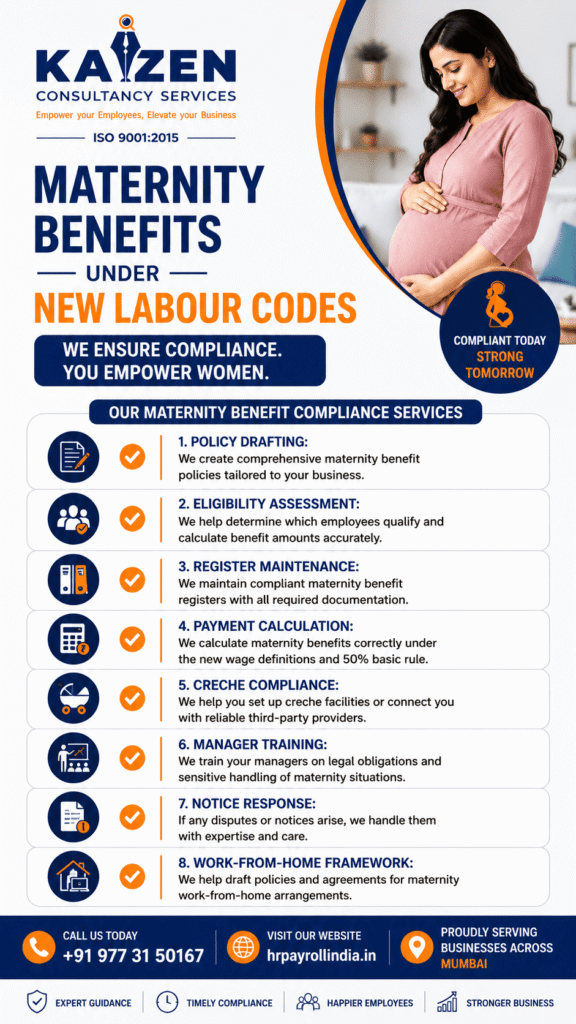
✅ Policy Drafting: We create comprehensive maternity benefit policies tailored to your business.
✅ Eligibility Assessment: We help determine which employees qualify and calculate benefit amounts accurately.
✅ Register Maintenance: We maintain compliant maternity benefit registers with all required documentation.
✅ Payment Calculation: We calculate maternity benefits correctly under the new wage definitions and 50% basic rule.
✅ Creche Compliance: We help you set up creche facilities or connect you with reliable third-party providers.
✅ Manager Training: We train your managers on legal obligations and sensitive handling of maternity situations.
✅ Notice Response: If any disputes or notices arise, we handle them with expertise and care.
✅ Work-From-Home Framework: We help draft policies and agreements for maternity work-from-home arrangements.
Why Employers Trust Kaizen for Maternity Benefits:
Contact Kaizen Consultancy Services Today:
Get your free maternity benefit policy review—we'll ensure you're fully compliant with the new codes while supporting your women employees properly.
Because maternity benefits aren't just legal obligations—they're opportunities to build a supportive, inclusive workplace that attracts and retains the best talent.
Get your free HR compliance audit under the New Labour Codes—we'll identify gaps and provide a clear action plan. Because HR compliance isn't just about avoiding penalties—it's about building a sustainable, legally sound organization ready for growth.