
Consultation
+91 97731 50167
HR Compliance Under New Labour Code
If you’re managing HR for any business in Mumbai—whether you’re a startup with 10 employees or an established company with 500—November 2025 marked a watershed moment in Indian labour law. The New Labour Codes came into full effect, and they didn’t just tweak existing rules. They fundamentally restructured how HR compliance works in India.
The irony? Most HR teams are still operating with pre-2025 mindsets. They’re maintaining old registers, following outdated processes, and unknowingly exposing their companies to penalties that have increased 5-10 times under the new regime.
This isn’t about scaring you. It’s about preparing you. The New Labour Codes aren’t inherently bad—in many ways, they’ve simplified compliance by consolidating 29 scattered laws into just 4 comprehensive codes. But simplification doesn’t mean easy. It means different. And different requires learning, adapting, and sometimes completely overhauling your HR compliance systems.
Let’s walk through exactly what’s changed and what your HR department needs to do right now to stay compliant, HR Compliance under New Labour code
Digital-First Compliance - Everything Goes Online
The New Labour Codes mandate digital compliance for practically everything.
Shram Suvidha Portal—Your Single Window: Gone are the days of registering separately with EPF office, ESI office, labor department, and factories inspector. Now, most registrations happen through the unified Shram Suvidha Portal (shramsuvidha.gov.in).
What you register on Shram Suvidha:
- Initial establishment registration
- Annual returns for various compliances
- Inspection requests and responses
- Notice submissions and acknowledgments
Other mandatory portals:
- EPFO Unified Portal: For monthly ECR filing, PF registrations, and employee claims
- ESIC Portal: For ESI registrations, monthly returns, and medical benefits
- Income Tax Portal: For TDS filings, Form 16 generation
- State PT Portals: For Professional Tax (varies by state—Maharashtra uses MAITRI portal)
What this means for HR: Your HR team needs digital literacy. Staff members who've been filing paper returns for 20 years need training on navigating these portals. Budget for:
- Digital signature certificates for authorized signatories (₹1,000-2,000/year)
- Training for HR staff on portal usage
- Reliable internet connectivity and computers
- Password management systems (you'll have 5-10 portal logins to maintain)
Deadline compliance is stricter: Digital systems track everything with timestamps. You can't claim "the post was delayed" anymore. If the deadline is 15th and you file on 16th, the system automatically calculates penalties.
Privacy considerations: Store Aadhaar numbers securely with encryption. Under India's data protection regulations, unauthorized disclosure of Aadhaar information attracts penalties.
New Registers HR Must Maintain
The codes prescribe specific registers that must be maintained—digitally or physically.
Form IV - Wage Register (Code on Wages): Must contain for each employee:
- Name, father's name, designation
- Date of joining and leaving
- Daily/monthly wages with breakup
- Deductions itemized
- Net wages paid with payment mode
- Signature of employee receiving wages
Update frequency: Every pay cycle (monthly/weekly)
Muster Roll (Working Conditions Code): Daily attendance showing:
- Employees present/absent
- Overtime hours worked
- Leave taken (with type—casual, sick, earned)
Update frequency: Daily
Leave Register: Track for each employee:
- Earned leave balance
- Casual leave balance
- Sick leave balance
- Leaves taken with dates and reasons
- Leave encashment details
Maternity Benefit Register: For women employees:
- Maternity leave applications
- Medical certificates
- Leave dates and duration
- Benefits paid
- Post-delivery joining dates
Bonus Register: If paying bonus:
- Calculation basis
- Eligible employees
- Amount paid to each
- Payment dates and mode
Inspection Book: Record of all labor department inspections:
- Date of inspection
- Inspector's name and designation
- Observations made
- Compliance certificates issued
Digital or Physical? The codes allow digital registers, but they must be:
- Readily accessible during inspections
- Backed up regularly
- Printable on demand
- Protected from unauthorized alterations
Most Mumbai companies now use HRMS software that maintains these registers automatically. If you're still using Excel sheets, consider upgrading.
Working Hours and Overtime: Stricter Limits
The Occupational Safety Code standardizes working hours across industries.
Standard limits:
- Maximum 8 hours per day
- Maximum 48 hours per week
- One rest day per week (Sunday or rotational)
Overtime rules: Any work beyond 8 hours/day or 48 hours/week is overtime, which must be paid at double the regular rate.
New Labour Code
What HR must track
- Actual hours worked by each employee daily
- Overtime hours separately recorded
- Overtime wages calculated at 2x normal hourly rate
- Overtime limits not exceeded (generally 50 hours overtime per quarter)
For IT and other exempt sectors: While some exemptions exist for managerial and supervisory staff, these are narrower than before. Don't assume your entire IT company is exempt. Only specific roles qualify.
Flexi-time and work-from-home: The codes allow flexible working arrangements but require proper policies documenting:
- Core hours when employees must be available
- How working hours are tracked for remote workers
- Overtime approval processes for flexible arrangements
Enhanced Penalties - What Non-Compliance Now Costs
The penalty structure under the new codes has teeth.
For wage-related violations:
- Delayed wage payment: ₹20,000 to ₹50,000 per violation
- Wrong deductions from wages: ₹10,000 to ₹40,000
- Non-maintenance of wage registers: ₹20,000 to ₹50,000
For social security violations:
- Delayed PF deposit: 12% annual interest plus damages up to 100% of contribution amount
- Non-registration under ESI: ₹10,000 to ₹1,00,000
- False information in statutory returns: ₹50,000 to ₹1,50,000
For working conditions violations:
- Exceeding working hour limits: ₹50,000 to ₹1,50,000
- Non-compliance with safety standards: ₹2,00,000 to ₹3,00,000
- Employment of children: ₹50,000 to ₹1,00,000 plus imprisonment up to 3 years
Repeat offenses: Penalties double or triple for repeat violations within 5 years.
Criminal liability: For willful violations, fraud, or violations causing safety hazards, imprisonment provisions range from 3 months to 3 years.
The bottom line: The "chalta hai" approach to compliance that many Mumbai businesses followed pre-2025 is now financially suicidal.
The Compliance Calendar - What's Due When
HR must track multiple compliance deadlines every month, quarter, and year.
Monthly (by 15th):
- EPF challan deposit and ECR filing
- ESI contribution payment
Monthly (by 7th):
- TDS deposit and challan filing
Monthly (by last day):
- Professional Tax deposit and return (varies by state)
Quarterly:
- TDS return filing (Form 24Q)
- ESI return filing (half-yearly now, but quarterly planning needed)
Annually:
- Form 16 issuance to employees (by June 15)
- PF annual returns (Forms 3A, 5, 6A by April 30)
- Bonus calculations and payments (if applicable)
- Income tax return filing
Ongoing:
- Daily wage register updates
- Daily muster roll maintenance
- Monthly leave register updates
- Immediate reporting of workplace accidents
Pro tip: Create a compliance calendar in Excel or use HR software with automatic deadline reminders. Missing even one deadline can trigger penalties.
Maternity Benefits - Extended and Enhanced
The Code on Social Security maintains the enhanced maternity benefits introduced in 2017 amendments.
26 weeks paid maternity leave: For women with less than two children, maternity benefit is 26 weeks at full wages.
12 weeks for third child onwards: Women with two or more existing children get 12 weeks.
Adoption and surrogacy: Commissioning mothers and adoptive mothers get 12 weeks from the date the child is handed over.
Work from home option: After the mandatory post-delivery leave period, women can request work-from-home for the remaining period if job nature permits.
Nursing breaks: Post-return, two paid breaks per day for nursing the child until 15 months of age.
Creche facilities: Establishments with 50+ employees must provide creche facilities (this is often overlooked in Mumbai offices).
Contractor and Gig Worker Compliance
The Code on Social Security extends social security to gig workers and platform workers for the first time.
If you engage contractors: You're a "principal employer" with joint liability for statutory compliance. Even if the contractor defaults, you're liable for workers' PF, ESI, and wages.
HR must:
- Verify contractor's license and registrations before engagement
- Collect monthly proof of PF/ESI deposits for contract workers
- Maintain register of contract workers on premises
- Ensure minimum wage compliance even for contract workers
If you use gig workers/freelancers: Depending on nature of engagement, you might need to provide social security benefits. The rules are still evolving, but if freelancers work exclusively for you with regular monthly payments, they might be deemed employees.
Safe harbour approach:
- Use clear contractor agreements specifying they're independent
- Pay per project/invoice, not monthly salaries
- Don't provide employee-like benefits
- Don't exercise employee-like control over their work methods
Notice Period and Termination Rules
The Industrial Relations Code standardizes notice periods and retrenchment processes.
Termination notice periods:
- Workmen: 30 days' notice or wages in lieu
- Non-workmen: As per employment contract (typically 30-90 days)
Retrenchment compensation: Workers with 1+ year of continuous service get:
- 15 days' wages for every completed year of service
- Notice period wages or notice in writing
- This is in addition to gratuity
Layoff provisions: Temporary suspension of workers requires:
- Prior permission from government if establishment has 300+ workers
- Layoff compensation (50% of wages) if layoff exceeds specified periods
Principal Employer risk explained under New labour code
What HR must document
- Valid reasons for termination (performance issues, misconduct, redundancy)
- Progressive discipline records (warnings, show-cause notices, replies)
- Termination letters with clear reasons
- Full and final settlement within prescribed timelines (typically 2-10 days depending on type of employment)
Wrongful termination risks: Under the new code, wrongful termination can result in:
- Reinstatement orders from labour courts
- Back wages for the entire period of dispute
- Compensation for harassment
Fixed-Term Employment - New Flexibility
The codes introduce clear provisions for fixed-term employment—a major change for industries with project-based or seasonal work.
What's allowed: Employers can hire workers on fixed-term contracts for specific projects, seasons, or durations.
Employee rights: Fixed-term employees get same benefits as permanent employees:
- Pro-rata gratuity (even if less than 5 years)
- PF, ESI, and other statutory benefits
- Earned leave proportionate to service period
- Working conditions at par with permanent staff
What HR must do:
- Clear employment contracts specifying fixed term and project
- Same wage scales as permanent employees doing similar work
- Pro-rata gratuity calculation at contract end
- Proper documentation if contracts are renewed
Benefits: This gives Mumbai businesses flexibility to hire for specific projects without permanent liability, while still ensuring worker protection.
HR Compliance Audit - What to do Now
If you haven't already, conduct an immediate HR compliance audit against the new codes.
Salary restructuring check: ✓ Have all salaries been restructured to 50% basic minimum?
✓ Are revised contracts/letters issued to all employees?
✓ Is your payroll system updated with new structures?
Digital portal compliance:
✓ Are you registered on Shram Suvidha Portal?
✓ Do you have valid digital signatures for all authorized persons?
✓ Are login credentials documented and backed up?
Register maintenance:
✓ Are all prescribed registers being maintained?
✓ Are they updated as per prescribed frequency?
✓ Are digital backups taken regularly?
Aadhaar seeding:
✓ Have you collected Aadhaar from all employees?
✓ Is Aadhaar linked with UAN for all employees?
✓ Is Aadhaar data stored securely?
Statutory payment compliance:
✓ Are all monthly PF/ESI payments happening by 15th deadline?
✓ Is TDS being deposited by 7th?
✓ Are payment records maintained and accessible?
Working hours tracking:
✓ Do you have systems to track actual hours worked?
✓ Is overtime being calculated and paid correctly?
✓ Are rest day requirements being met?
Contractor management:
✓ Have you verified all contractors' licenses and registrations?
✓ Are you collecting monthly compliance proofs?
✓ Is the contract labour register maintained?
Get Expert Help from Kaizen Consultancy Services
The New Labour Codes represent the most significant change in Indian labour law in 50 years. For HR departments trying to stay compliant while handling recruitment, payroll, employee relations, and daily operations, it's overwhelming.
Kaizen Consultancy Services has been Mumbai's trusted labour law advisor for 18+ years. We've helped hundreds of companies transition smoothly to the new compliance framework.
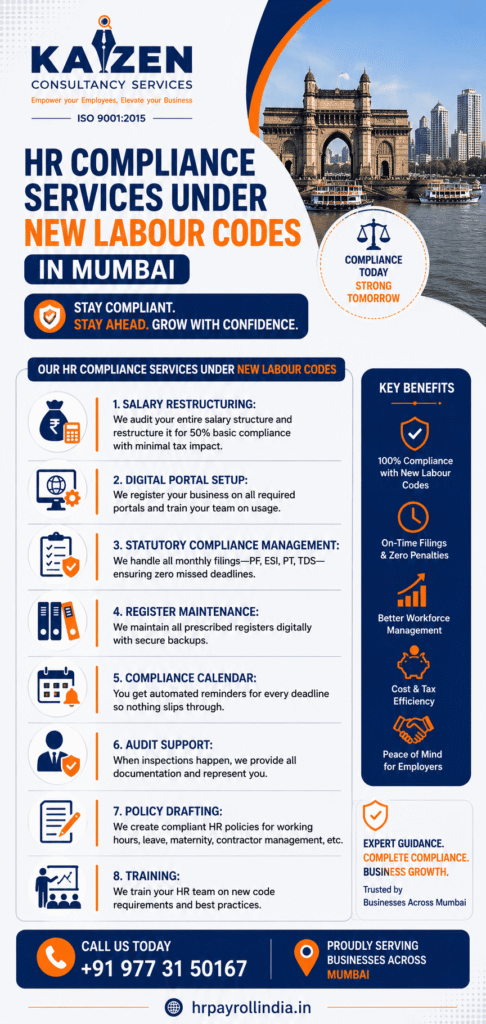
Our HR Compliance Services Under New Labour Codes:
✅ Salary Restructuring: We audit your entire salary structure and restructure it for 50% basic compliance with minimal tax impact.
✅ Digital Portal Setup: We register your business on all required portals and train your team on usage.
✅ Statutory Compliance Management: We handle all monthly filings—PF, ESI, PT, TDS—ensuring zero missed deadlines.
✅ Register Maintenance: We maintain all prescribed registers digitally with secure backups.
✅ Compliance Calendar: You get automated reminders for every deadline so nothing slips through.
✅ Audit Support: When inspections happen, we provide all documentation and represent you.
✅ Policy Drafting: We create compliant HR policies for working hours, leave, maternity, contractor management, etc.
✅ Training: We train your HR team on new code requirements and best practices.
Get your free HR compliance audit under the New Labour Codes—we'll identify gaps and provide a clear action plan. Because HR compliance isn't just about avoiding penalties—it's about building a sustainable, legally sound organization ready for growth.