
Consultation
+91 97731 50167
Women in Night Shifts and Equal Remuneration
The text message came at 10 PM: “Can you work the night shift tomorrow?”
For Priya, a quality control officer at a Mumbai manufacturing unit, this question meant a dilemma. The night shift paid 15% more than the day shift—extra money she needed. But it also meant concerns about safety, transportation, and the physical toll of working nights as a woman.
In 2025, this situation plays out thousands of times across Mumbai’s factories, hospitals, BPOs, and service establishments. And under the New Labour Codes, how you handle women in night shifts and equal remuneration has become a legal and ethical minefield that many employers don’t understand.
The Occupational Safety, Health and Working Conditions Code, 2020 and the Code on Wages, 2019 have introduced strict provisions about women’s night shift work and equal pay. Get it wrong, and you’re facing penalties of ₹1,00,000 to ₹3,00,000, plus potential criminal prosecution, plus lawsuits from affected women employees.
At Kaizen Consultancy Services, we’ve guided over 200 Mumbai employers through this compliance area. Here’s everything you need to know about women in night shifts and equal remuneration under the New Labour Codes—explained in plain language, with real examples from Mumbai businesses.
Women working night shifts is now a reality under the New Labour Codes. But this opportunity comes with responsibility—to ensure safety, to ensure equal pay, to ensure dignity.
When you get this right, everyone benefits: women have well-paying jobs with genuine safety, your business has stable night shift workforce, and you operate without compliance worries.
When you get it wrong, the cost is steep—financially, legally, and ethically.
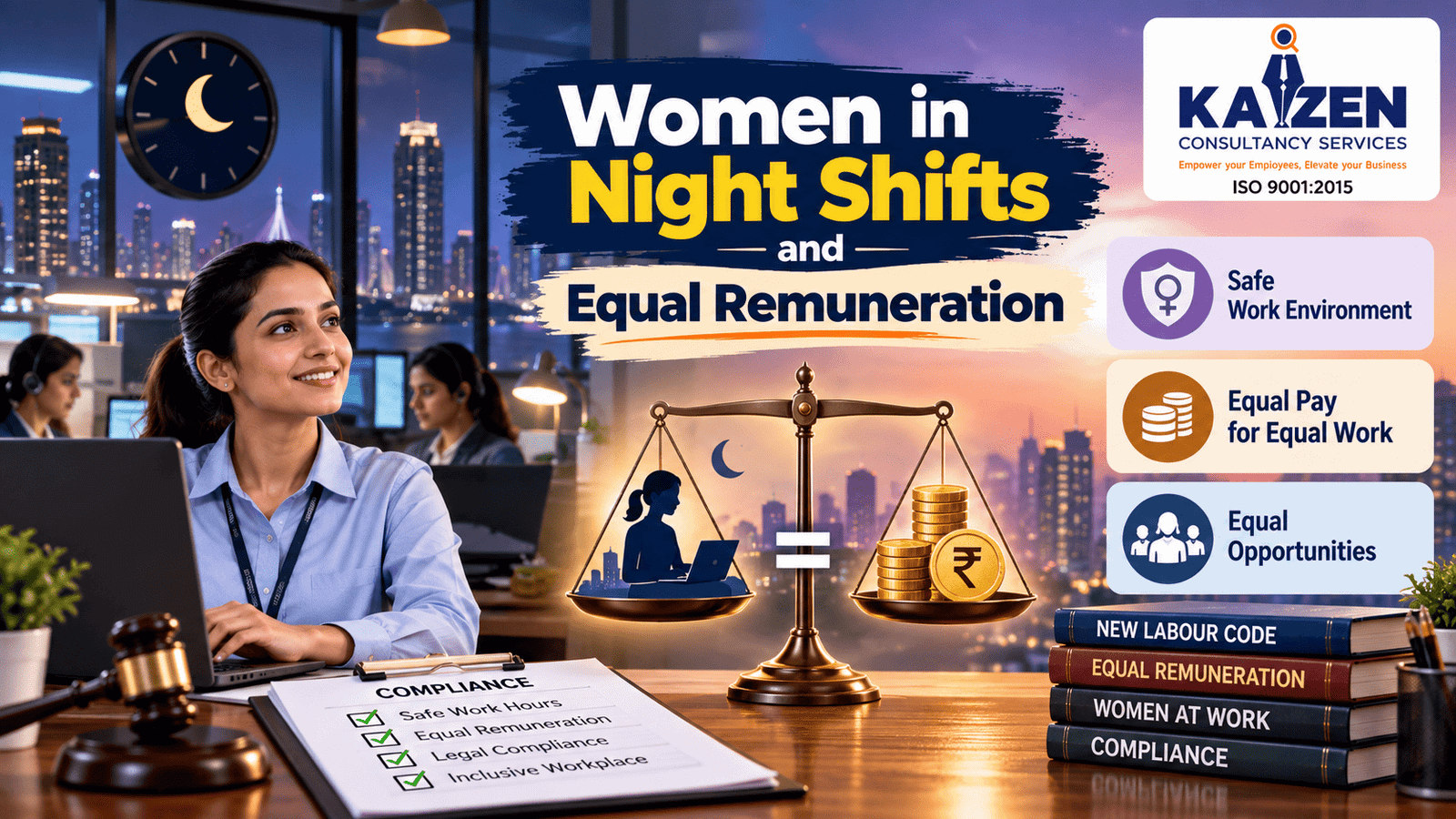
The New Reality: Women's Night Shift Rights Under New Labour Code
Before November 2025, women's night shift work was largely prohibited under the Factories Act. The new codes changed this fundamentally—but with conditions that many employers are misunderstanding.
What Changed: The Legal Shift
Under the old Factories Act:
- Women couldn't work between 10 PM and 5 AM
- Exceptions required government permission
- Essentially, women night shift work was prohibited in most cases
Under the New Occupational Safety Code, 2020:
- Women CAN work night shifts (6 PM to 6 AM)
- But extensive conditions and safeguards apply
- Employer liability for safety is strict
- Equal pay for equal work is mandatory
This doesn't mean night shifts are now "free for all." It means night shifts are permitted only when employers meet specific safety and compensation requirements.
What "Equal Remuneration" Really Means Under New Labour Code
This is where many Mumbai employers stumble. They think "equal remuneration" means "same salary." That's partially correct, but incomplete.
The Legal Definition of Equal Remuneration
According to the Code on Wages, 2019, equal remuneration means:
"Equal wages for work of equal value performed by a man or woman worker without discrimination based on gender."
This has three critical components:
- Same Job = Same Pay
If a woman does the exact same work as a man in the same position, they must receive identical salary. No exceptions. - Work of Equal Value = Equal Pay
Even if job titles differ, if the work contributes equally to the organization, compensation must be equal. - No Gender-Based Discrimination
Any difference in pay based on gender is automatically discriminatory—even if masked as different allowances or benefits.
What Equal Remuneration Does NOT Mean
It doesn't mean identical benefits for everyone: You can offer specific benefits (like transportation subsidies for night shift workers, or nursing breaks for women with young children) without violating equal remuneration—as long as they're available equally and not used as disguised pay cuts.
It doesn't prohibit shift premiums: You can pay MORE for night shift work (if genuinely difficult or requiring extra hours), but if women are paid LESS than men for the same night shift work, that's discrimination.
It doesn't require identical hours: You can have flexible arrangements, but compensation must be proportional to actual work done.
Real Mumbai Example: The Night Shift Discrimination Case
Let me walk you through a real situation we handled:
The Setup
Vikram's pharmaceutical manufacturing unit in Vikhroli had 80 employees—20 in the quality control department working night shifts. Of these 20:
- 8 were women
- 12 were men
- All did identical quality checking work
- All worked the same 8-hour night shift (10 PM to 6 AM)
The Compensation Structure (Problematic)
Men working night shifts:
- Basic: ₹18,000
- DA: ₹3,000
- Night shift premium: ₹2,500
- Total: ₹23,500
Women working night shifts:
- Basic: ₹16,000
- DA: ₹2,500
- "Transportation allowance": ₹2,000 (actually replacing shift premium)
- "Welfare allowance": ₹1,500 (discretionary, often not paid)
- Total: ₹22,000 (but actually ₹20,500 if welfare allowance wasn't paid)
What Was Wrong
On the surface, it looked like Vikram was being thoughtful—providing transportation for women working nights, which is actually good. But the implementation was discriminatory:
- Lower basic salary for women (₹16,000 vs. ₹18,000)—direct gender discrimination
- Different premium structure—night shift premium (guaranteed) for men, "welfare allowance" (discretionary) for women
- Disguised pay reduction—the transportation allowance was lower than the shift premium, effectively paying women less
- No transparent justification—no documented reason why women deserved lower basic pay
The Consequences
One of the women employees discovered she was earning ₹1,500 less monthly than her male colleague doing identical work. She filed a complaint with the labour department.
Labour department investigation revealed:
- Systematic gender-based pay discrimination
- Eight affected women employees
- Violation period: 18 months
- Total back-pay owed: ₹2,16,000 (8 women × ₹1,500 × 18 months)
- Plus interest at 12% annually
- Plus penalties: ₹1,00,000+
How we Solved it
We helped Vikram:
- Immediately restructured compensation:
- Equalized basic salary (₹18,000 for all)
- Equalized DA (₹3,000 for all)
- Maintained night shift premium (₹2,500 for all)
- Offered transportation subsidy equally (₹1,000 for anyone working night shifts)
- Calculated back-pay correctly:
- ₹2,16,000 to affected women employees
- Negotiated installment payment plan with labour department
- Implemented transparent policy:
- Written compensation policy clearly showing equal pay principle
- Documented justification for any allowances
- Annual audit of pay equity
- Documented the correction:
- Formal intimation to all affected employees
- Communication about why changes were made (legal compliance)
- Assurance that future compensation would be equitable
Result: Vikram avoided a ₹3,00,000+ total liability by fixing the issue after discovery. The cost of correction was high but preventable with proper understanding from day one.
Conditions for Women Working Night Shifts Under New Labour Code
If you want women to work night shifts, the law requires you to provide specific protections. These aren't optional—they're mandatory.
Safety and Transportation Requirements
- Safe Transportation
You must provide:
- Safe transport from workplace to home
- Preferably dedicated vehicle (not public transport)
- For shifts ending after midnight
- At no cost to the employee
What "safe" means: The vehicle should:
- Be well-lit and secure
- Have female staff or attendants
- Have a fixed, predictable route
- Be available every shift (not "whenever possible")
Mandatory Break and Rest Provisions
- Mandatory Rest Period
- Women working night shifts must get at least 11 hours rest between shifts
- Cannot be called for consecutive night shifts without adequate rest
- This is stricter than for male workers (who get 10.5 hours)
- Health Breaks
- Dedicated breaks for health issues related to night work
- Access to healthcare facilities during shift
- Medical check-ups (paid by employer) at least annually
Safety Personnel and Workplace Requirements
- Safety Infrastructure
- Well-lit workplace (not dim lighting for night shifts)
- Clean, accessible toilets (separate facilities for women)
- Rest room for breaks
- First aid facilities immediately available
- Emergency alarm systems
- Security Measures
- Security staff present during night shifts
- CCTV coverage of work areas (except restrooms/change rooms)
- Clear reporting mechanism for safety concerns
- Designated safety officer trained in women's safety
Notification and Prohibition Requirements
- Government Notification
- For establishments with 50+ employees, you must notify the government of women night shift work
- This is informational, not permission-seeking, but documentation is crucial
- Childcare Provisions
If employing women with children under 6 years:
- Creche facilities mandatory (within premises or arrangement with external creche)
- Women cannot be forced to work if childcare arrangement fails
Equal Remuneration: What You must do as an Employer
Mandatory Pay Equity Audit
Under the Code on Wages, you must ensure:
- Job Classification Transparency
- Clear job descriptions for every position
- Documented criteria for pay differences
- Regular review of job classifications
- Pay Structure Transparency
- Written salary structures for each role/level
- Clear documentation of any allowances
- Justification for any different treatment
- Gender-Neutral Compensation
- Basic salary not differentiated by gender
- Allowances not discriminatory
- Shift premiums applied equally
- Regular Audits
- At least annual pay equity audits
- Comparing men and women in similar roles
- Identifying and correcting gaps
What Requires Justification (If You Have Different Pay)
You CAN pay differently if you have legitimate, documented reasons:
Legitimate reasons:
- Experience level: Woman with 2 years experience vs. man with 10 years—different pay is justified
- Seniority: Woman junior vs. man senior—justified
- Performance: Woman with lower performance rating—justified (with documented performance metrics)
- Qualifications: Woman without required certification—justified
- Market conditions: Shortage of certain skills commands higher pay (applies to all genders)
Illegitimate reasons (Never Acceptable):
- "Women naturally cost less" ✗
- "Women are secondary earners" ✗
- "Women don't need higher pay" ✗
- "Most women in this role earn less" ✗
- "Industry standard for women in this role" ✗
Any pay difference based solely on gender, regardless of how it's justified, violates the Code on Wages.

Night Shift Compliance for Different Mumbai Industries
Manufacturing Units (Factories in Thane, Vikhroli, MIDC)
Common issues:
- Women on assembly lines working night shifts with inadequate safety
- Transportation arrangements missing or unsafe
- Rest room facilities absent or poorly maintained
Compliance requirements:
- Dedicated safe transport mandatory
- Well-lit, secure work areas
- Female safety attendant or CCTV coverage
- Separate changing room and toilet facilities
Hospitals and Healthcare (Across Mumbai)
Common issues:
- Female nurses on night shifts without rest facilities
- Equal pay for equal work violated
- Childcare arrangements absent
Compliance requirements:
- Safe rest area for night shift staff
- On-site childcare or arrangement
- Equal pay for equal shifts
- Mandatory health check-ups
BPOs and Call Centers (Andheri, Powai, etc.)
Common issues:
- Women on night shift without transportation
- Restroom facilities inadequate
- Health concerns from irregular shifts ignored
Compliance requirements:
- Guaranteed safe transport home
- 11-hour rest mandatory between shifts
- Health monitoring for night shift workers
- Safety staff present during shifts
Retail and Hospitality (Across Mumbai)
Common issues:
- Women working late-night shifts with inadequate safety
- No transportation provided
- Equal remuneration not ensured
Compliance requirements:
- Safe transport from mall/restaurant to home
- Security presence during closing procedures
- Equal pay for identical shift work
- Clear safety protocols
Common Misconceptions About Women's Night Shifts
Misconception 1: "Women Can't Work Nights Under New Labour Code"
The myth: The codes prohibit women from night shift work.
The reality: Women CAN work nights, but employers must provide strict safety measures and equal compensation. It's not a prohibition—it's a responsibility framework.
Misconception 2: "Transportation Allowance Replaces Equal Pay"
The myth: If I give women a transportation allowance, I can pay them less.
The reality: Transportation is a working condition benefit, not a salary substitute. A woman working the same night shift as a man must receive equal base salary PLUS any applicable transportation support.
Misconception 3: "Women Should Accept Less Pay for Night Shifts"
The myth: Women on night shifts have more responsibilities (safety concerns, childcare), so they should accept lower pay.
The reality: The Code on Wages is clear: equal work = equal pay, regardless of additional responsibilities. If a woman has childcare concerns, that's for you to address through creche facilities, not by paying her less.
Misconception 4: "Wellness Allowance for Women is Separate from Night Shift Premium"
The myth: I pay men ₹2,500 night shift premium and women ₹2,000 wellness allowance plus ₹500 health allowance—that's equal.
The reality: If the total is different and based on gender, it's discriminatory. Allowance structures cannot be used to create gender-based pay differences.
Misconception 5: "Married Women Should Prefer Day Shifts"
The myth: I'm being considerate by offering day shifts to married women and night shifts to single women (at higher pay).
The reality: Women must have the choice. Forcing or discouraging women from night shifts based on marital status violates both equal remuneration and non-discrimination principles.
How to Ensure Compliance: Step-by-Step for Mumbai Employers
Step 1: Audit Your Current Night Shift Workforce
Document:
- How many women work night shifts?
- What positions do they hold?
- How many men work identical positions?
- What's the compensation comparison?
- What safety measures exist?
- What transportation arrangements exist?
Step 2: Compare Compensation
For each woman in night shift:
- Find a man doing the same/equivalent work (on day or night shift)
- Compare base salary (should be identical)
- Compare all allowances (should be identical or justified)
- Compare total compensation (should be identical)
- Document any differences and their justification
Step 3: Implement Safety Measures
If you don't have:
- Safe, dedicated transportation ➜ Arrange immediately
- Well-lit, secure workplace ➜ Upgrade immediately
- Rest facilities ➜ Create or upgrade immediately
- Security staff/CCTV ➜ Implement immediately
- Emergency protocols ➜ Document immediately
Step 4: Fix Pay Inequities
If you find women earning less than men for equal work:
- Calculate total back-pay owed
- Determine payment plan (lump sum or installments)
- Communicate transparently to affected women
- Revise compensation structure going forward
- Document the correction process
Step 5: Get Formal Review
Have a labour consultant:
- Review compensation structures
- Assess safety compliance
- Recommend specific improvements
- Help implement changes
Real Impact: Cost of Non-Compliance
If you have 5 women earning ₹1,500 less monthly than comparable men for 12 months:
- Back-pay owed: ₹90,000
- Interest at 12% annually: ₹10,800
- Penalties: ₹50,000 to ₹1,00,000
- Potential legal fees: ₹50,000 to ₹2,00,000
Total exposure: ₹2,00,000 to ₹4,00,000 for a simple pay equity issue
Cost of getting it right from the start: ₹10,000 to ₹20,000 for a compliance audit and pay equity review
Women Employees' Rights You Must Know
Right to Safe Work
Women have the right to:
- Safe, well-lit workplace
- Secure rest facilities
- Access to healthcare
- Protection from harassment
Right to Safe Transport
Women working night shifts have the right to:
- Free transportation to and from home
- Safe, secure vehicle
- Consistent, predictable transport
- No shared vehicle with strangers
Right to Equal Remuneration
Women have the right to:
- Equal pay for equal work
- No discrimination in allowances
- Transparent compensation structure
- Equal progression and benefits
Right to Rest and Health
Women have the right to:
- 11 hours rest between shifts (not 10.5)
- Regular health check-ups (paid by employer)
- Health breaks during shift
- Childcare arrangements (if needed)
Right to Refuse Unsafe Night Shifts
If safety measures aren't in place:
- Women can refuse to work without penalty
- Refusal isn't insubordination
- You cannot deduct pay for this refusal
Critical point: If you don't have proper safety arrangements and a woman is injured on a night shift, you're liable for:
- Medical costs
- Disability compensation
- Loss of wages
- Potentially criminal negligence charges
Case Study: Getting It Right from Day One
The Correct Approach
Anjali runs a 120-person manufacturing unit in Vikhroli. When she introduced night shifts, she did it right:
- Safety first
- Well-lit production floor (500 lux minimum)
- Separate, lockable restroom facilities
- Clean, comfortable rest room
- Security guard present 10 PM-6 AM
- CCTV in production areas (not rest areas)
- Transportation
- Dedicated vehicle with female attendant
- Leaves at 6 AM sharp (after shift end)
- Direct route to employees' homes
- No shared rides with male employees
- Free for employees
- Equal compensation
- Women: Basic ₹20,000 + DA ₹4,000 + Night premium ₹2,500 = ₹26,500
- Men doing same work: Basic ₹20,000 + DA ₹4,000 + Night premium ₹2,500 = ₹26,500
- No difference, no justification needed (work is identical)
- Health support
- Quarterly health check-ups (paid)
- Doctor available for health concerns
- Flexible restroom break access
- Permission for rest when unwell
- Childcare
- Partnership with nearby creche for night shift workers' children
- Subsidy (₹2,000/month) toward creche costs
- Creche has evening hours (until 6:30 AM)
Result:
- Zero compliance issues in 3 years of operation
- No employee complaints
- Women actively prefer these night shifts (good compensation, safe conditions)
- Business continuity with reliable night shift staffing
- Reputation as "women-friendly employer" attracts talent
What Mumbai Employers should do Now
Immediate Actions
This week:
- Audit your compensation: List any women earning less than comparable men
- Audit safety: Check if night shift women have safe transportation and rest facilities
- Document current state: Write down what you currently provide
This month:
- Fix obvious inequities: Bring women's pay to equal levels
- Implement minimum safety: Arrange safe transportation if missing
- Get professional review: Hire a labour consultant to audit compliance
Ongoing Compliance
Monthly:
- Monitor for new night shift assignments
- Ensure safe transportation for all night shift women
- Review incident reports or complaints
Quarterly:
- Pay equity review: Check compensation hasn't drifted
- Safety audit: Verify all safety measures are functioning
Annually:
- Formal pay equity audit: Independent review of all compensation
- Safety review: Full assessment of night shift work conditions
- Policy update: Revise policies as laws evolve
Contact Kaizen Consultancy for Women's Night Shift Compliance
Women’s night shift compliance is complex, but necessary. Get it wrong, and you’re facing ₹2,00,000 to ₹5,00,000 in liability. Get it right, and you have a safer, more equitable workplace that attracts better talent.
Kaizen Consultancy Services offers:
✅ Pay Equity Audit
- Review all compensation
- Identify gender-based inequities
- Calculate back-pay if needed
- Recommend restructuring
✅ Night Shift Safety Audit
- Assess current safety measures
- Identify gaps
- Recommend improvements
- Help implement safeguards
✅ Compliance Documentation
- Help create clear policies
- Document all safety measures
- Maintain required records
- Prepare for inspections
✅ Employee Communication
- Transparent communication about compensation
- Education on new rights and protections
- Grievance handling support
Contact Kaizen Consultancy Services for New Labour Code Training in Mumbai, Thane, Navi Mumbai Transform your HR team into compliance experts. Schedule training today.