
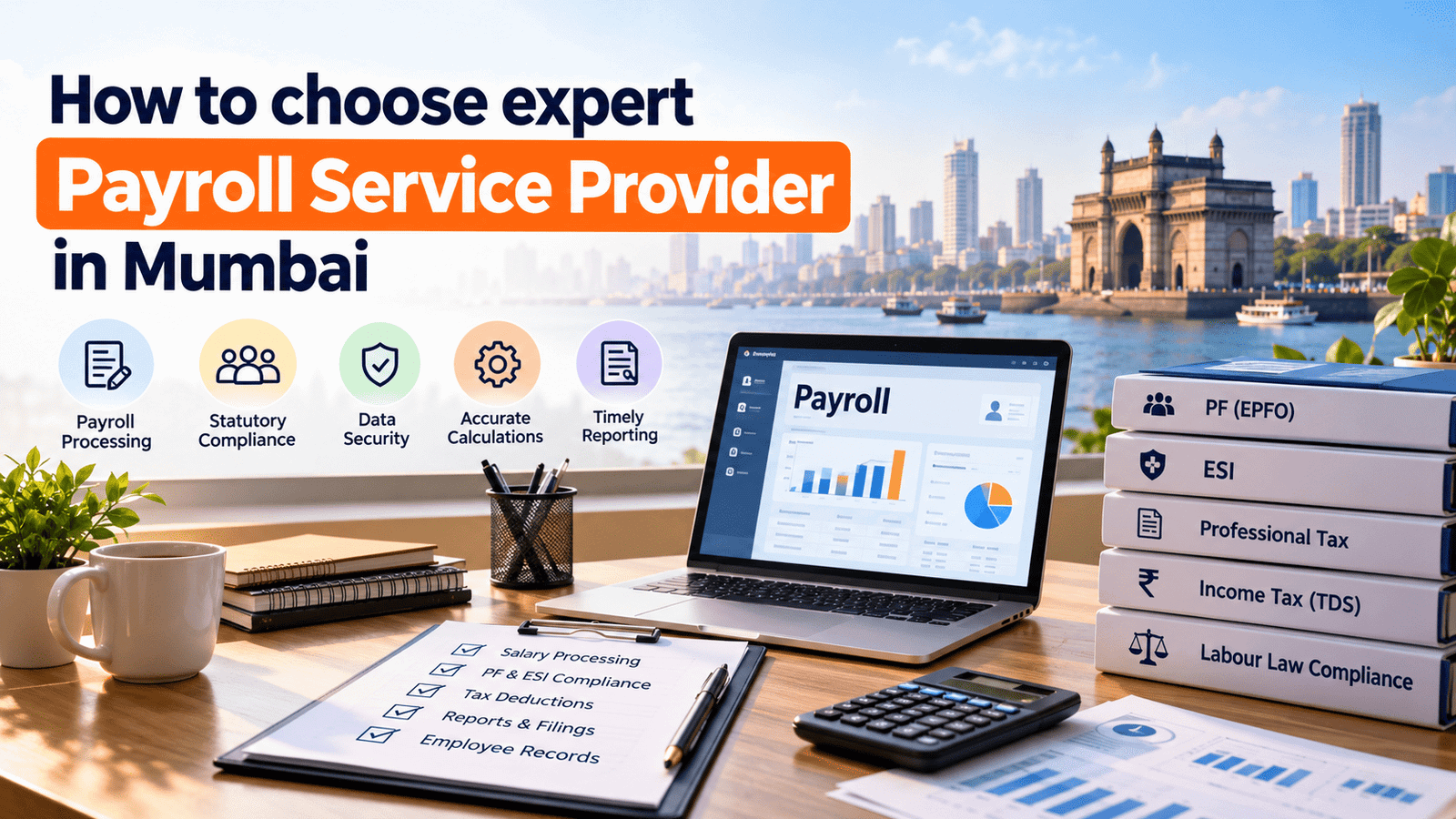
How to choose expert Payroll Service provider in Mumbai

Choosing the right payroll outsourcing services is an important decision for any business. Salary processing may look simple, but it involves more than calculating how much an employee should receive each month.

A business may need to manage salary payments, PF, ESI, professional tax, income-tax deductions, employee records and other applicable labour-law requirements.

The biggest risk is choosing a payroll provider who calculates salaries but does not keep up with changes in labour laws and statutory compliance.

For businesses looking for Payroll Outsourcing Services in Mumbai, the right service provider should help you understand your responsibilities, calculate payroll correctly, meet applicable deadlines and maintain proper records.

This guide explains what to check before hiring a payroll outsourcing company, How to choose payroll outsourcing service provider in Mumbai after changes in New Labour Code even if you have little knowledge of payroll or labour laws.

How to choose payroll service provider in mumbai for new labour code
Used AI to create image - How to choose Payroll Service Provider for New Labour Code

This guide explains what to check before hiring a payroll outsourcing company, even if you have little knowledge of payroll or labour laws.

01 · The basics

What Are Payroll Outsourcing Services?

Payroll outsourcing means hiring an external service provider to manage some or all of your company's salary-processing activities.

Depending on the agreement, the service provider may calculate salaries, prepare payslips, calculate applicable deductions, prepare payroll reports and support statutory compliance.

For example, a company with 25 employees may not have a dedicated payroll department. Instead, it can engage a payroll outsourcing provider to process salaries every month and assist with PF, ESI and related compliance.

However, outsourcing payroll does not automatically remove the employer's legal responsibilities. The exact obligations depend on applicable law and the arrangements in place.

02 · Legal knowledge

Why Is Current Labour-Law Knowledge Important When Choosing a Payroll Provider?

Labour laws, government notifications and tax requirements can change. A payroll provider must know which requirements apply to your business and update its calculations and processes accordingly.

Here are some important developments that a payroll provider should understand as of October 2026.

New Labour Codes

The Central Government brought the four Labour Codes into effect from 21 November 2025. The Ministry of Labour & Employment has also issued guidance explaining the revised definition of wages and the transitional treatment of existing rules to the extent they remain consistent with the Codes.

Your payroll provider should understand how these changes affect wage calculations, employee benefits and applicable compliance requirements.
Revised Definition of Wages and the 50% Rule

Under the Ministry's published FAQs, certain excluded components that exceed 50% of the relevant total remuneration must be added back to wages for statutory calculations, subject to the legal definition and exclusions. This is often referred to as the 50% rule.

This does not simply mean that every employee's basic salary must be exactly 50% of gross salary. The actual calculation requires a review of the applicable components and statutory provisions.

PF Wage Ceiling Increased to ₹25,000

The Central Government notified an increase in the statutory wage ceiling for mandatory EPFO coverage from ₹15,000 to ₹25,000 per month, effective 17 September 2026, through Gazette Notification S.O. 5109(E). EPFO's employer portal now displays FAQs relating to the revision.

A payroll provider should know how to assess affected employees, review contribution calculations and handle the September 2026 transition.

The revised ceiling should not be applied blindly to every employee. Previous membership, employee eligibility, applicable wage calculations and scheme provisions must also be considered.

ESI Requirements

The Ministry's additional FAQs dated 16 March 2026 stated that the existing ₹21,000 monthly wage ceiling for ESI coverage remained applicable at that time. This is separate from the revised PF wage ceiling, so the two should not be confused.

A reliable payroll provider should check for subsequent notifications before processing payroll.

Income-Tax Changes Affecting Salary Processing

The Income Tax Department's official guidance explains that salary payments from April 2026 onwards are governed by the applicable provisions of the Income Tax Act, 2025, including Section 392(1) for salary TDS in the new tax year.

The Department also states that payroll and related systems must be updated to reflect the new section numbering and reporting requirements.

Maharashtra-Specific Requirements

Businesses in Mumbai may also need to comply with Maharashtra- specific requirements, including applicable professional-tax rules and rates.

The Maharashtra tax department publishes professional-tax rate schedules and notifications, including updates issued in 2026.

What to check: Ask the payroll provider how it tracks new notifications, who reviews legal changes and how your company is informed when an update affects payroll.

Official reference sources: Ministry of Labour & Employment , EPFO Employer Portal , ESIC , Income Tax Department and Maharashtra GST Department .

03 · Services and deliverables

What Services Should a Payroll Outsourcing Company Provide?

Before comparing providers, understand which services your business needs. A reliable payroll outsourcing company should clearly explain what it handles, what your internal team must do, and which services are included in the agreed fee.

1. Monthly salary processing

Salaries are calculated using approved employee details, attendance, salary structures and other relevant payroll data.

2. Payslip preparation

Employees receive a clear statement showing their salary components, applicable deductions and take-home salary.

3. PF compliance support

Assistance with applicable PF calculations, employee records, contribution reconciliation and Electronic Challan-cum-Return (ECR) filing.

4. ESI compliance support

Assistance with employee eligibility, applicable contributions, employee records and required reporting.

5. Professional tax

Calculation and reporting of applicable Maharashtra professional tax according to the relevant requirements.

6. Salary TDS

Calculation and reporting of applicable income-tax deductions from employee salaries.

7. Attendance and leave management

Payroll calculations reflect approved attendance, leave, overtime and other relevant inputs under the applicable rules and company policy.

8. Full and final settlement

Calculation of applicable salary dues, eligible leave encashment, reimbursements and other amounts when an employee leaves the company.

9. Payroll reconciliation

Payroll totals are compared with salary payments, deductions, contribution records and other relevant statutory records to identify discrepancies.

10. Compliance reporting

Payroll reports, applicable filing acknowledgements and payment evidence are provided according to the agreed service scope.

Important: Not every payroll outsourcing provider includes all these services in its standard fee. Ask for a written list of included services, additional charges, filing responsibilities and documents you will receive each month.

04 · Choosing the right provider

4. How to choose the payroll service provider in Mumbai after New Labour Code

Check experience in payroll and labour-law compliance

Do not choose a provider only because it offers low-cost salary processing.

Ask whether it has experience handling businesses similar to yours in terms of employee count, salary structure, industry and compliance requirements.

A business with salaried office staff may have different needs from a factory, a restaurant or an organisation that employs contract workers.

Ask how the provider handles legal changes

A knowledgeable provider should be able to explain how it handles changes such as the revised PF ceiling, the definition of wages, applicable ESI requirements and current Maharashtra professional-tax rules.

Ask for examples of its update process and how it verifies information against official sources.

Check who will handle your payroll

Find out whether your account will be managed by an experienced payroll professional or passed between different team members.

You should know whom to contact when a salary is incorrect, an employee raises a query or a statutory deadline is approaching.

Check the technology used

Ask which payroll software or systems the provider uses and whether it can generate the reports your business needs.

The important point is not simply whether the provider uses modern software. It is whether the calculations, employee data and statutory outputs are reviewed properly.

Understand data security

Payroll records contain sensitive information such as salary details, bank information and employee identifiers.

Before sharing data, ask how the provider restricts access, securely receives files, maintains backups and handles a suspected data breach.

Also, retain appropriate control over your company's official accounts and access credentials. EPFO itself advises employers to maintain strong passwords and not share passwords.

Check client references and accountability

Ask for relevant client references, a sample of the reports delivered and an explanation of how mistakes are corrected.

You should understand who will investigate errors, how corrections will be documented and how quickly issues will be addressed under the service agreement.

05 · Questions to ask

5. Questions you should ask before choosing a provider

A short discussion can tell you a lot about the provider's knowledge and working style.

Ask:

“How will you check whether PF applies to each of my employees after the revised ₹25,000 ceiling?”

The provider should explain that employee eligibility and applicable wage calculations need to be assessed rather than applying one rule to everyone.

“How will you inform me when labour laws or statutory rates change?”

You should receive timely, understandable information about changes that affect your business, together with their effective dates and the action required.

“Will you send me proof after completing statutory filings and payments?”

The answer should clearly identify the reports, challans, acknowledgements and other records you will receive.

“What happens if you make a payroll error?”

Ask how an error is reported, investigated, corrected and documented, and whether any additional charge applies.

“Who is responsible for supplying information and approving payroll?”

The provider should define its responsibilities and your responsibilities in writing. You should know who approves the final salary register and who authorises payments.

“What happens if I decide to change payroll providers?”

You should understand how your employee records, reports and other business data will be returned or transferred securely.

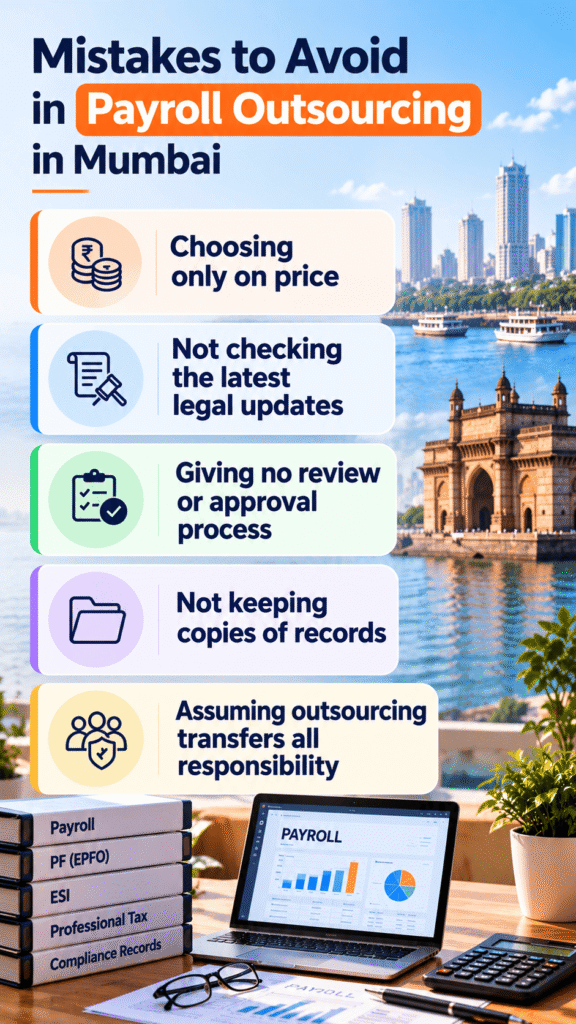
Mistakes to avoid choosing payroll service provider in Mumbai

7. How does payroll outsourcing work?

A clear payroll process should follow defined steps every month.

Step 1: Provide employee information

Share approved details on new joiners, exits, attendance, leave, salary changes and other payroll inputs through a secure process.

Step 2: Calculate payroll

The provider processes salaries, deductions and applicable statutory contributions using the agreed rules and verified data.

Step 3: Review and approve

You receive the draft payroll and review unusual changes, new deductions and the overall salary cost before approval.

Step 4: Process payments and filings

Salary payments and applicable statutory payments or filings are completed by the responsible party under the agreed scope.

Step 5: Receive reports and evidence

You receive the agreed payslips, payroll reports, reconciliation and applicable filing or payment evidence.

This process helps the business retain visibility over salary costs and statutory payments without having to perform every payroll calculation internally.

8. Common mistakes to avoid

Choosing only on price

A cheap service may be unsuitable if it does not cover the payroll and compliance requirements of your business.

Not checking the latest legal updates

Outdated PF ceiling settings, incorrect wage calculations or obsolete tax references can cause errors. Ask how the provider verifies its legal information.

Giving the provider no review or approval process

Even when payroll is outsourced, management should have a clear way to check and approve the final payroll.

Not keeping copies of records

Your business should be able to access its payroll registers, payslips, payment evidence and relevant compliance records when needed.

Assuming outsourcing transfers all responsibility

The service agreement should explain the division of work, but outsourcing does not automatically remove obligations imposed on the employer by law.

Why choose Kaizen Consultancy Services for payroll outsourcing in Mumbai?

For a business owner, the goal is not just to pay employees. It is to pay them correctly, understand the salary cost, meet applicable obligations and keep proper records.

Kaizen Consultancy Services supports businesses with payroll and related compliance requirements, including:

  • Monthly payroll processing and payslips.
  • PF and EPFO compliance support.
  • ESI registration and contribution support.
  • Salary structure and payroll review.
  • Payroll reconciliation and compliance audits.
  • Professional tax and applicable salary-tax deduction support.
  • HR documentation and labour-law compliance assistance.

The appropriate service scope can be discussed according to the number of employees, your current payroll process and the level of support your business requires.

Choose expert payroll outsourcing services in Mumbai

Selecting a payroll partner is a decision about trust, accuracy and ongoing support. A suitable provider should help you understand what is being calculated, which obligations apply, what needs approval and what evidence you should retain.

Kaizen Consultancy Services offers payroll, PF, ESI and labour-law compliance support for businesses in Mumbai and surrounding areas.

Contact Kaizen Consultancy Services to discuss your employee count, payroll requirements and the compliance support your business needs.

Kaizen Consultancy Services — Payroll, PF, ESI and Labour Law Compliance Consultants in Mumbai.

Contact Kaizen Consultancy Services for New Labour Code Consultancy, Training in Mumbai, Thane, Navi Mumbai Transform your HR team into compliance experts. Schedule training today.