1
Identify Affected Employees
Prepare a list of employees whose relevant wages fall between ₹15,000 and ₹25,000.
Check whether they were previously outside EPFO coverage because of the old wage ceiling.

The Central Government has revised the statutory wage ceiling for mandatory EPFO coverage from ₹15,000 to ₹25,000 per month, effective from 17 September 2026.
The change has been notified through Gazette Notification S.O. 5109(E), dated 17 September 2026, issued by the Ministry of Labour & Employment under the Code on Social Security, 2020.
For employers, this is more than just a change in a payroll figure. It can affect employee coverage, PF contributions, EPS and EDLI, payroll processing, ECR filing and employee take-home salary.
Here is what the revised PF wage ceiling means in practical terms.
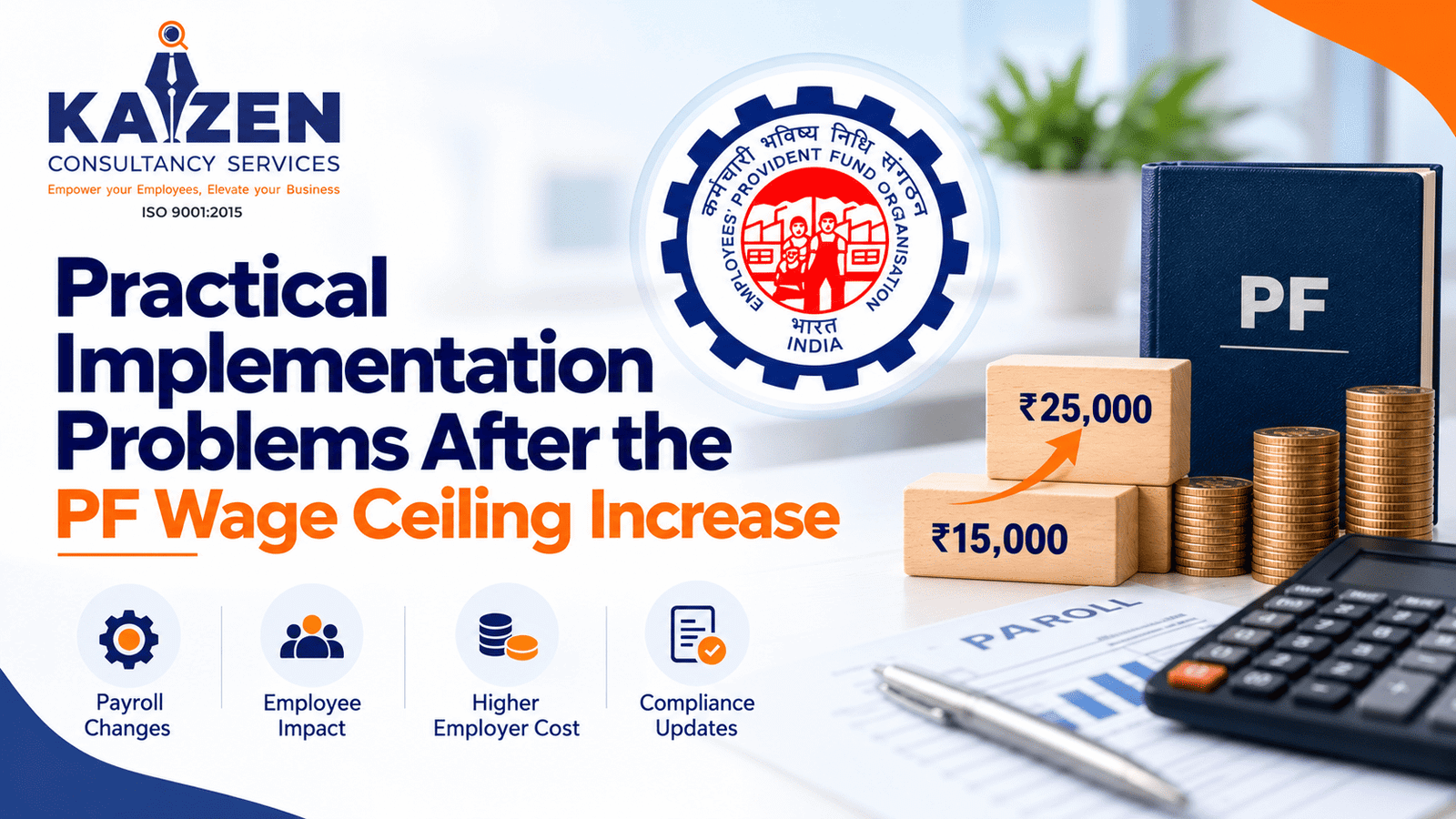
For many years, the statutory PF wage ceiling was ₹15,000 per month.
The ceiling was increased to ₹15,000 in September 2014 and remained unchanged for more than a decade.
Under the earlier framework, an eligible new employee whose relevant monthly wages exceeded ₹15,000 could generally fall outside mandatory EPF coverage, subject to the applicable provisions and conditions.
This meant that employees in the ₹15,001 to ₹25,000 range could, in certain circumstances, remain outside mandatory EPFO coverage because their wages were above the earlier ceiling.
The situation has now changed.
The Central Government has increased the statutory wage ceiling from:
₹15,000 → ₹25,000 Per Month
The revised ceiling is effective from 17 September 2026.
Through Gazette Notification S.O. 5109(E), the Central Government has notified ₹25,000 per month as the wage ceiling for the purposes of Chapter III of the Code on Social Security, 2020.
Chapter III deals with the Employees' Provident Fund framework.
The Government has stated that the revision is expected to bring more than 51 lakh additional employees within mandatory EPFO coverage, subject to the applicable provisions.
The revised framework relates to the applicable EPFO social-security benefits, including:
The exact treatment of an employee depends on the applicable statutory and scheme provisions.
Important Point for Employers
The ₹25,000 figure should not be interpreted as meaning that every employee earning ₹25,000 or less will automatically have PF calculated on their entire gross salary.
PF applicability and contribution are determined according to the applicable definition of wages, scheme provisions and the employee's circumstances.
The change is particularly relevant for employees in the ₹15,000 to ₹25,000 wage range who were previously outside mandatory EPFO coverage because their relevant wages exceeded the old ceiling.
For example:
An eligible new employee with relevant wages of ₹20,000 could fall outside mandatory EPF coverage because the statutory ceiling was ₹15,000.
The revised ₹25,000 ceiling can bring employees in this range within the expanded mandatory coverage framework, subject to the applicable conditions.
The Government estimates that the change could extend mandatory EPFO coverage to more than 51 lakh additional employees.
Existing PF members may also be affected where the revised ceiling changes the applicable contribution base.
The revised ceiling can have several practical implications for businesses.
HR and payroll teams should identify employees whose relevant wages fall between ₹15,000 and ₹25,000 and check whether they were previously outside EPFO coverage because of the old ceiling.
Where PF contributions are calculated on the revised ceiling, the employee's PF deduction may increase.
For example, at a 12% employee contribution rate:
₹15,000 × 12%
₹25,000 × 12%
However, the actual deduction for an individual employee depends on the applicable PF wage base and relevant statutory provisions.
The employer's statutory contribution may also increase for affected employees, depending on the applicable contribution base and scheme provisions.
Payroll systems may need to be updated to reflect the revised ceiling and applicable calculations.
Employers should also review their ECR filing process to ensure that the contribution figures and employee records are correctly reported.
For some employees, a higher PF contribution can result in a reduction in monthly take-home salary.
At the same time, the employee may build higher PF savings and receive the applicable pension and insurance benefits under the relevant schemes.
This is an important practical point because the revised ceiling did not start from the first day of September.
The new ceiling became effective on 17 September 2026.
Therefore, September 2026 needs special attention.
The previous ₹15,000 ceiling applies.
The revised ₹25,000 ceiling applies, subject to the applicable provisions.
EPFO's implementation guidance provides for the September wage month to be handled through the applicable single ECR, with contributions calculated appropriately for the two periods.
Employers should therefore carefully review their September payroll and ECR calculations rather than applying the ₹25,000 ceiling to the entire month without considering the effective date.
The revision requires HR, payroll and compliance teams to review their existing processes.
Prepare a list of employees whose relevant wages fall between ₹15,000 and ₹25,000.
Check whether they were previously outside EPFO coverage because of the old wage ceiling.
Do not determine PF applicability only by looking at the employee's gross salary.
Review the applicable definition of PF wages and the relevant salary components before determining the contribution base.
Ensure that your payroll system reflects the revised statutory ceiling and the applicable EPF, EPS and EDLI calculations.
Since the change became effective from 17 September, verify that September contributions have been calculated correctly for the applicable periods.
Review the September ECR carefully and ensure that employee records and contribution figures are consistent with the revised requirements.
Employees affected by the change should understand why their PF deduction or take-home salary may change.
Clear communication can help avoid confusion when the revised contribution appears on the payslip.
Businesses should also review their contract workforce and payroll arrangements to determine whether any employees or contract workers are affected by the revised PF ceiling.
The increase in the PF wage ceiling from ₹15,000 to ₹25,000 can have a direct impact on payroll processing, employee deductions and statutory compliance.
For employers, the main challenge is not only understanding the new ceiling. The bigger challenge is implementing the change correctly in payroll and explaining its impact to employees.
Some employees may see a higher PF deduction, while employers may see an increase in their statutory contribution and payroll cost. HR and payroll teams also need to ensure that employee records, contribution calculations and ECR filing are correctly updated.
One of the first issues can arise when payroll software or internally maintained salary sheets continue to use the old ₹15,000 ceiling.
If the payroll system is not updated, the PF contribution may be calculated incorrectly.
What to do:
Businesses may have employees who were previously outside mandatory PF coverage because their relevant wages were above ₹15,000.
The revised ceiling means these employees need to be reviewed under the applicable provisions.
This can create additional work for HR and payroll departments, particularly in organisations with a large number of employees.
What to do:
Create an employee-wise report showing:
| Employee | Relevant PF wages | Earlier status | Revised status | Employee contribution | Employer contribution |
|---|---|---|---|---|---|
| Employee A | ₹18,000 | Review required | Review | As applicable | As applicable |
| Employee B | ₹22,000 | Review required | Review | As applicable | As applicable |
| Employee C | ₹28,000 | Above ceiling | Review | As applicable | As applicable |
This makes it easier to identify employees requiring further action.
One of the most important concerns for employees will be:
In some cases, yes.
If the employee's applicable PF contribution base increases, the employee contribution deducted from salary can also increase.
For example, if the applicable PF contribution is calculated at 12%:
₹15,000 × 12% = ₹1,800 employee contribution
₹25,000 × 12% = ₹3,000 employee contribution
The difference is:
₹3,000 − ₹1,800 = ₹1,200 per month
Therefore, where the full revised ceiling becomes the applicable PF contribution base, the employee's monthly take-home salary could reduce by up to ₹1,200 because of the employee PF contribution.
However, this should not be applied automatically to every employee.
The actual PF deduction depends on the applicable PF wages, employee category and relevant statutory and scheme provisions.
Suppose an employee previously received:
Gross salary: ₹30,000
PF deduction: ₹1,800
Other deductions: ₹500
Take-home salary:
₹30,000 − ₹1,800 − ₹500 =
₹27,700
If the applicable PF contribution increases to ₹3,000:
₹30,000 − ₹3,000 − ₹500 =
₹26,500
In this example, the employee's take-home salary reduces by ₹1,200 per month.
At the same time, the employee's PF savings increase by the corresponding contribution, subject to the applicable rules.
The impact is not limited to the employee.
Where the applicable PF contribution base increases, the employer's statutory contribution may also increase.
For businesses operating on a fixed CTC structure, this can create an additional payroll-cost consideration.
For example, if an employer's contribution increases because the applicable contribution base moves from ₹15,000 to ₹25,000, the additional statutory contribution could affect the overall salary cost or CTC structure.
Therefore, employers should review:
Another practical problem can arise when employees are offered a fixed CTC.
Employees often look at their CTC as their expected annual compensation.
However, if the employer's statutory contribution increases within the same CTC, the employee's take-home salary may change.
CTC = Salary + Employer PF + Other statutory components
After the PF ceiling revision, the employer's contribution may increase.
If the CTC remains unchanged, the additional employer contribution may reduce the amount available under other salary components.
Therefore, HR should clearly explain whether the revised PF contribution is:
This distinction is important for employee communication.
Another implementation challenge is that not every employee will be treated in exactly the same way.
A company may have:
Therefore, applying one blanket rule to the entire payroll can create errors.
What to do?
Perform an employee-wise PF applicability review rather than changing the contribution setting for everyone at once.
The revised ceiling became effective from 17 September 2026, rather than from 1 September.
This creates a special calculation requirement for the September wage month.
Employers need to consider the applicable treatment for:
EPFO's implementation guidance provides for the September wage month to be handled through the applicable single ECR, with the contribution calculated appropriately for the two periods.
This makes September payroll particularly important to verify.
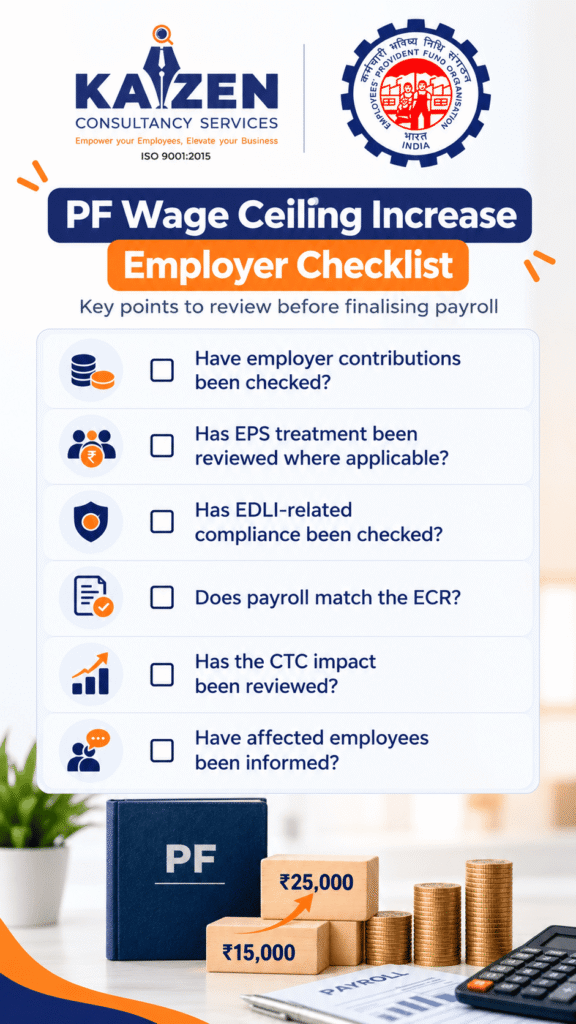
What should employers do?
Check the employee's applicable PF wage.
Verify the effective date.
Check the contribution calculation for both periods.
Reconcile payroll with the ECR.
Verify employee and employer contributions.
Check EPS-related calculations where applicable.
Preserve the calculation sheet for future reference.
An employee may see a lower take-home salary and immediately ask:
If the HR department has not communicated the change properly, it can lead to unnecessary confusion.
Employees should be informed that PF is not simply a salary deduction. The employee contribution forms part of their statutory social-security savings, while applicable employer contributions and other benefits are governed by the relevant provisions.
What should HR explain?
A simple before-and-after payslip illustration can be particularly useful.
The implementation may involve several operational issues.
These issues can be reduced through a structured payroll review.
The revised PF wage ceiling can create questions for both employers and employees.
Kaizen Consultancy Services can help businesses review the practical impact of the change and implement the revised requirements systematically.
If your organisation has employees in the ₹15,000 to ₹25,000 wage range, reviewing your PF applicability and payroll calculations now can help identify implementation issues early.
Contact Kaizen Consultancy Services for professional assistance with PF compliance, payroll review and implementation of the revised ₹25,000 PF wage ceiling. Kaizen Consultancy Services – PF, ESIC, Payroll & Labour Law Compliance Consultants in Mumbai