
Consultation
+91 97731 50167
Payroll Terminology Complete Guide
Payroll involves calculating employee salaries, making applicable deductions, paying salaries on time and maintaining the records required by law. Understanding payroll terminology helps businesses avoid calculation errors and manage their employment costs.
For businesses looking for Labour Law in Mumbai, payroll knowledge is an important starting point because salary processing can involve wage laws, PF, ESI, professional tax, income-tax deductions and other applicable statutory obligations. Payroll Terminology Complete guide explained.
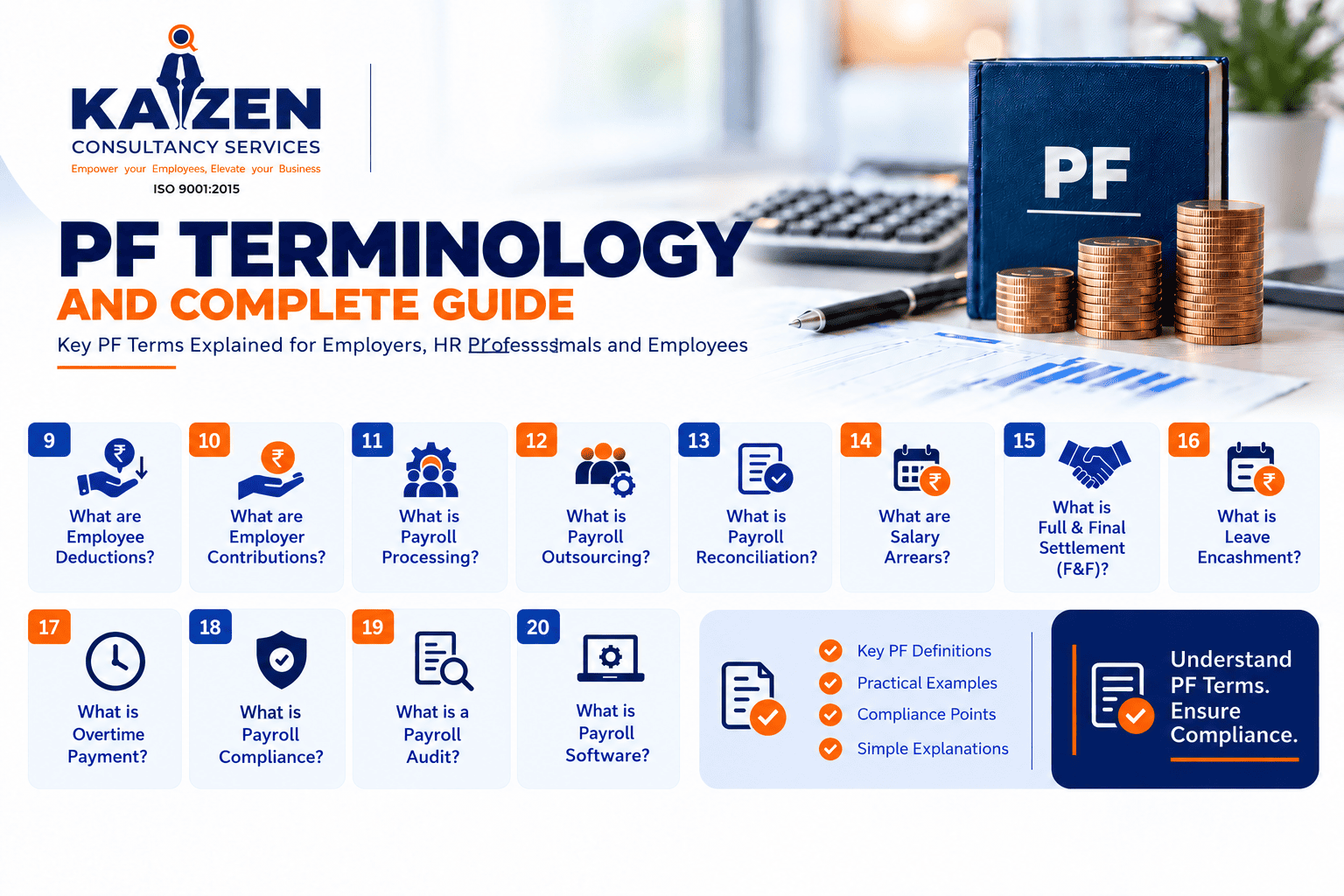
The following glossary explains common payroll terms with practical examples.
1. What is payroll?
Meaning: Payroll is the process of calculating and paying employees' salaries for a particular period.
It includes calculating salary, allowances, overtime where applicable, deductions, employer contributions and the final amount payable to employees.
Example: A company calculates the October salaries of 25 employees, deducts applicable PF and other amounts, prepares payslips and transfers their salaries to their bank accounts. This entire process is part of payroll processing.
Why it matters: Incorrect payroll calculations can lead to salary disputes, incorrect statutory payments and compliance problems.
2. What is CTC (Cost to Company)?
Meaning: CTC is the total annual cost a company incurs for employing a person under its compensation structure.
Depending on the employment package, it may include salary, employer PF contributions, gratuity provisions, insurance and other benefits.
Example: An employee has an annual CTC of ₹6,00,000. This does not necessarily mean the employee will receive ₹50,000 every month in their bank account because CTC may include employer contributions and other benefits.
Why it matters: Employers should clearly explain the difference between CTC and actual take-home salary when issuing offer letters.
3. What is gross salary?
Meaning: Gross salary is the salary payable before deductions from the employee's salary.
It generally includes the salary components payable to the employee, such as basic salary and applicable allowances.
Example: An employee receives ₹25,000 as basic salary and ₹10,000 as allowances. If these are the only salary components, the gross salary is ₹35,000 before deductions.
Important: Gross salary and wages for statutory calculations are not necessarily the same. Different laws may prescribe different definitions and calculation methods.
4. What is net salary or take-home salary?
Meaning: Net salary is the amount an employee receives after applicable deductions.
These may include employee PF contributions, ESI contributions where applicable, professional tax, income-tax withholding and other lawful deductions.
Example: If gross salary is ₹35,000 and total deductions are ₹3,000, the take-home salary is ₹32,000.
Formula:
Net salary = Gross salary − Applicable employee deductions
The exact calculation depends on the employee's salary structure and applicable deductions.
5. What is basic salary?
Meaning: Basic salary is the core salary component specified in an employee's compensation structure.
It is often used in calculating certain employment benefits, but the applicable legal definition of wages may include or exclude components according to the relevant law.
Example: An employee's monthly salary structure includes basic salary of ₹20,000 and HRA of ₹8,000.
The basic salary is ₹20,000, but it should not automatically be treated as the wage base for every statutory calculation.
6. What is dearness allowance (DA)?
Meaning: Dearness allowance is an allowance intended to help employees cope with changes in the cost of living.
It is commonly associated with certain public-sector and other employment arrangements, depending on the applicable terms.
Why it matters: Where applicable, DA can form part of the relevant wage calculation under employment and statutory rules.
7. What is house rent allowance (HRA)?
Meaning: HRA is an allowance provided by an employer to help an employee meet accommodation expenses.
Its treatment for salary structure and income-tax purposes depends on the applicable rules and the employee's circumstances.
The Income Tax Department distinguishes allowances from perquisites and explains their tax treatment in its official guidance.
Example: An employee receives basic salary of ₹25,000 and HRA of ₹10,000 per month.
HRA is a separate component in the salary structure. Its treatment for income tax and labour-law calculations must be assessed under the relevant rules.
8. What is a salary slip or payslip?
Meaning: A salary slip is a document showing an employee's salary details for a particular pay period.
It generally contains:
- Employee details and pay period
- Salary components
- Gross salary
- Applicable deductions
- Net salary payable
Why it matters: Payslips help employees understand their salary and deductions. They also support payroll records and the resolution of salary-related queries.
9. What are employee deductions?
Meaning: Employee deductions are amounts deducted from an employee's salary under applicable law or other lawful arrangements.
Examples may include:
- Employee PF contribution, where applicable
- Employee ESI contribution, where applicable
- Professional tax, where applicable
- Income tax deducted at source, where applicable
- Other legally permissible deductions
Employers should not make deductions simply because they appear in an internal payroll template. Each deduction must have an appropriate legal or contractual basis.
10. What are employer contributions?
Meaning: Employer contributions are amounts the employer pays towards applicable employee benefits or statutory schemes.
Depending on eligibility and applicable requirements, these may include employer PF and ESI contributions.
Important: Employer contributions and employee deductions are different. Employer contributions should not automatically be treated as amounts deducted from the employee's gross salary.
11. What is payroll processing?
Meaning: Payroll processing is the complete procedure used to calculate, verify and pay employee salaries.
It commonly involves attendance verification, salary calculations, applicable deductions, payslip preparation, payment processing and statutory reporting.
Practical example: A business checks attendance, calculates overtime, verifies PF and ESI applicability, prepares the payroll register and pays employees. These activities form part of payroll processing.
12. What is payroll outsourcing?
Meaning: Payroll outsourcing means engaging an external service provider to handle some or all payroll activities.
Depending on the agreed scope, the provider may help with salary calculations, payslips, payroll reports, statutory contribution calculations and compliance support.
Why businesses use it: Outsourcing can help reduce repetitive administrative work and improve payroll controls. However, outsourcing does not automatically remove an employer's legal responsibilities.
13. What is payroll reconciliation?
Meaning: Payroll reconciliation means comparing payroll calculations with supporting records to identify errors or differences.
For example, a business may compare:
- Payroll reports
- Salary payments
- PF and ESI contribution reports
- Statutory challans
- Applicable ECR records
Differences should be investigated and corrected through the appropriate process.
14. What are salary arrears?
Meaning: Salary arrears are amounts payable to an employee for an earlier period.
They may arise because of a delayed salary revision, correction of a previous calculation or another amount becoming payable retrospectively.
Example: An employee receives a salary revision effective from July, but it is processed in September. The additional amount payable for July and August may be treated as salary arrears.
The tax and statutory treatment depends on the nature of the payment and applicable rules.
15. What is full and final settlement (F&F)?
Meaning: Full and final settlement is the process of calculating and settling amounts payable when an employee leaves an organisation.
Depending on the circumstances, it may include unpaid salary, eligible leave encashment, approved reimbursements, applicable gratuity and other dues, after lawful deductions.
Why it matters: Employers should calculate the settlement correctly and follow the applicable legal timelines rather than relying on one universal deadline for every type of payment.
16. What is leave encashment?
Meaning: Leave encashment is payment for eligible unused leave, where the employee is entitled to receive such payment under applicable law, employment terms or policy.
The calculation and eligibility can differ according to the type of leave, establishment and applicable legal provisions.
17. What is overtime payment?
Meaning: Overtime payment is additional payment for qualifying work beyond prescribed working hours.
The entitlement, rate and conditions depend on the applicable law and the employee's category.
Employers should maintain accurate attendance and working-hour records and verify the applicable overtime requirements.
18. What is payroll compliance?
Meaning: Payroll compliance means processing salaries and related statutory obligations according to the laws applicable to the business and its employees.
It may involve wage payments, statutory contributions, deductions, records, returns and other applicable requirements.
For businesses seeking Labour Law Compliance in Mumbai, payroll compliance should be reviewed alongside the applicable Maharashtra requirements and relevant Central laws.
19. What is a payroll audit?
Meaning: A payroll audit is a review of salary calculations, employee records, deductions and related compliance processes.
It can help identify incorrect salary calculations, missed contributions, inconsistent employee records and errors in statutory reporting.
Practical benefit: Regular reviews can help businesses identify and correct problems before they become larger compliance issues.
20. What is payroll software?
Meaning: Payroll software is a system used to manage salary calculations, payslips, employee payroll records and related reporting.
Some systems also support attendance, leave management and statutory calculations.
Important: Using payroll software does not guarantee legal compliance. The software configuration, employee information and applicable legal requirements still need to be checked.
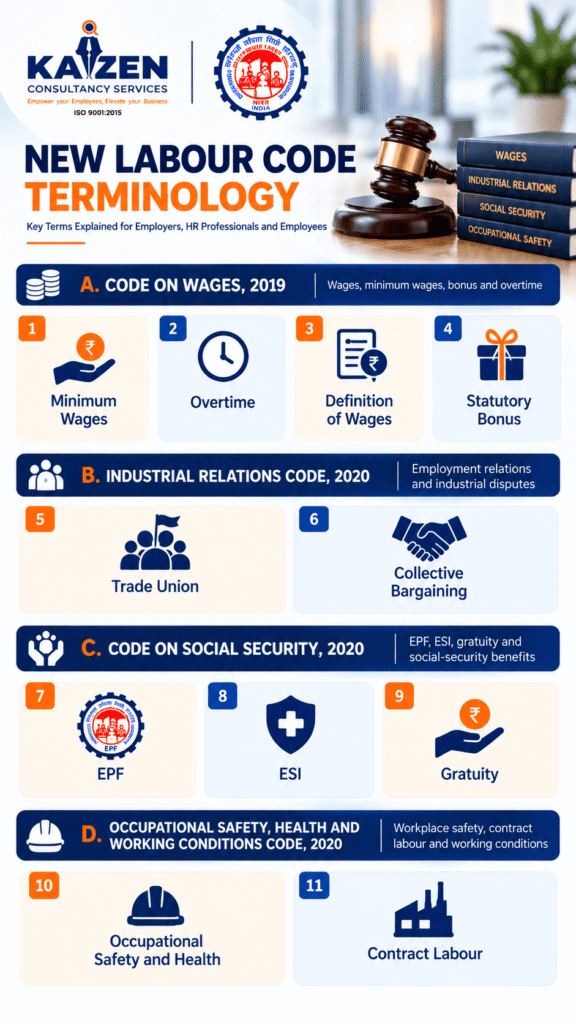
Part 2: New Labour Code glossary – Indian labour laws explained in simple English
For employers, HR professionals, business owners and employees seeking Labour Law guidance in Mumbai.
India's four Labour Codes consolidate and reorganise provisions relating to wages, industrial relations, social security, workplace safety and working conditions.
The Central Government announced that the four Labour Codes came into effect on 21 November 2025. Employers must still check the applicable rules, notifications and requirements relevant to their establishment and the particular provision.
This glossary explains the main terms in simple language and highlights why they matter in day-to-day business operations.
A. Code on Wages, 2019 Wages, minimum wages, bonus and overtime
The Code on Wages deals with wage-related matters, including minimum wages, payment of wages, bonus and equal remuneration.
1. What is the Code on Wages?
Meaning: The Code on Wages is an Indian law that brings together provisions concerning wages and bonus.
Why it matters: Employers need to understand the applicable wage requirements when structuring salaries, calculating payments and reviewing payroll compliance.
2. What are wages?
Meaning: Wages are amounts treated as wages under the applicable legal definition.
The legal definition is important because it determines which salary components must be considered for particular statutory calculations.
Example: An employee's salary may include basic salary, allowances and other payments. The amount treated as wages for a particular legal purpose must be determined using the applicable statutory definition, not merely the gross salary figure.
3. What are minimum wages?
Meaning: Minimum wages are the minimum rates prescribed by the appropriate government for covered employment.
Employers must check the applicable rate for the relevant employment, category and location.
Example: A business should verify the current minimum-wage rate applicable to its establishment and employee category before finalising salary payments.
4. What is a floor wage?
Meaning: A floor wage is a wage level determined by the Central Government under the Code on Wages framework.
It is distinct from the minimum-wage rates fixed by the appropriate government.
Why it matters: Employers should not assume that the floor wage and the minimum wage applicable to their establishment are interchangeable.
5. What is overtime?
Meaning: Overtime refers to qualifying work performed beyond the prescribed working hours for which additional payment may be due.
The entitlement and rate depend on the applicable legal provisions and employee category.
Employer responsibility: Maintain accurate working-hour records and verify the applicable overtime requirements.
6. What is the definition of wages under the Labour Codes?
Meaning: The legal definition of wages determines which remuneration components are included when calculating relevant statutory entitlements.
It should not be confused with the terms basic salary, gross salary or CTC.
Why it matters: The definition can affect calculations for benefits such as gratuity and other applicable statutory payments.
Maharashtra's Labour Department has published FAQs addressing the definition of wages and its application under the Labour Codes.
7. What is a statutory bonus?
Meaning: A statutory bonus is a bonus payable under applicable legal provisions when the relevant eligibility and other conditions are met.
Why it matters: Employers should check the applicable eligibility requirements, calculation rules and payment obligations rather than assuming that every employee is automatically entitled to the same bonus.
B. Industrial Relations Code, 2020 Employment relations and industrial disputes
The Industrial Relations Code addresses matters involving trade unions, employment conditions in covered establishments and the investigation and settlement of industrial disputes.
8. What is an industrial dispute?
Meaning: An industrial dispute is a disagreement relating to employment, non-employment, employment conditions or labour-related matters covered by the applicable law.
Example: A disagreement between workers and an employer over employment conditions may give rise to an industrial dispute.
9. What is a trade union?
Meaning: A trade union is an organisation formed to represent and protect workers' interests in employment-related matters, subject to applicable legal requirements.
10. What is collective bargaining?
Meaning: Collective bargaining is the process through which worker representatives and employers negotiate employment conditions.
Topics may include wages, working conditions and other employment-related matters.
11. What are standing orders?
Meaning: Standing orders are formal rules governing specified employment conditions in establishments covered by the relevant legal provisions.
They can address matters such as employee classification, attendance, misconduct and disciplinary procedures.
12. What is retrenchment?
Meaning: Retrenchment is a legally defined form of termination of employment. It does not mean every type of employee separation.
Why it matters: Employers should verify the applicable definition, exceptions, notice requirements and compensation obligations before proceeding with a retrenchment.
13. What is fixed-term employment?
Meaning: Fixed-term employment refers to employment for a specified period under the applicable employment terms and legal framework.
Example: A company hires an employee for a defined project period under a fixed-term employment agreement.
The applicable statutory rights and obligations must be checked before assuming that fixed-term employees have different or fewer benefits.
C. Code on Social Security, 2020 EPF, ESI, gratuity and social-security benefits
The Code on Social Security provides a framework for social-security benefits and related matters, including provident fund, employee state insurance, gratuity and maternity benefits.
14. What is social security?
Meaning: Social security refers to systems and benefits designed to provide financial or other protection against specified risks, such as retirement, sickness, maternity and employment-related injury.
15. What is EPF?
Meaning: Employees' Provident Fund is a retirement savings arrangement under the applicable EPF framework.
Employee and employer contributions are governed by the relevant statutory provisions and schemes.
Why it matters: Employers must assess employee coverage, calculate applicable contributions and maintain the required records.
16. What is ESI?
Meaning: Employees' State Insurance is a social-insurance framework that provides specified benefits to eligible insured persons and, where applicable, their families.
Depending on the applicable provisions, benefits can include medical care and certain cash benefits.
Employer responsibility: Check establishment coverage, employee eligibility, contributions and reporting requirements.
17. What is gratuity?
Meaning: Gratuity is a statutory employment benefit payable when the applicable eligibility and other legal conditions are met.
It is commonly associated with an employee's service with an employer.
Why it matters: Employers should maintain accurate employment and wage records and calculate gratuity according to the applicable legal provisions.
18. What is maternity benefit?
Meaning: Maternity benefit refers to benefits available to eligible women employees under the applicable legal framework.
The specific entitlement, eligibility requirements and duration must be checked against the governing provisions.
19. What are gig workers?
Meaning: Gig workers undertake work or participate in work arrangements generally outside the traditional employer-employee relationship, as defined under the applicable legal framework.
20. What are platform workers?
Meaning: Platform workers undertake work through an online platform or similar arrangement, subject to the relevant legal definition.
Why it matters: The Code on Social Security recognises gig and platform workers for the purpose of its social-security framework. Specific benefits and eligibility depend on the applicable provisions and schemes.
D. Occupational Safety, Health and Working Conditions Code, 2020 Workplace safety, contract labour and working conditions
This Code deals with occupational safety, health and working conditions for covered establishments and workers.
21. What is occupational safety and health?
Meaning: Occupational safety and health refers to measures intended to protect people from workplace hazards and support safe working conditions.
Example: A factory may need appropriate protective equipment, safety procedures and other safeguards according to the applicable requirements.
22. What is contract labour?
Meaning: Contract labour generally refers to workers engaged through a contractor in arrangements covered by the applicable legal framework.
Why it matters: Employers should review contractor arrangements, applicable registration or licensing requirements and statutory compliance responsibilities.
23. Who is a principal employer?
Meaning: A principal employer is a legally defined role under the relevant labour-law framework.
Depending on the applicable law and circumstances, the role may involve responsibilities relating to workers engaged through contractors.
24. What is an establishment?
Meaning: An establishment is a legally defined workplace, business or other entity covered by a particular law.
The definition can vary across legal frameworks, so employers should check the relevant provision rather than rely on a single definition for every purpose.
25. What are working conditions?
Meaning: Working conditions refer to the circumstances under which people perform their work.
They may include working hours, rest periods, safety measures, welfare facilities and other employment conditions covered by applicable law.
Additional Employment Terms Practical HR and employment terminology
What is an appointment letter?
Meaning: An appointment letter is a document that records the terms on which an employee is hired.
It may specify the job role, salary, date of joining, working conditions, probation period and other employment terms.
HR responsibility: Maintain accurate employment documentation and verify the appointment-letter requirements applicable to the establishment.
What is an employment contract?
Meaning: An employment contract records the terms and conditions governing the employment relationship.
It may cover salary, responsibilities, working hours, confidentiality, notice period and termination conditions.
Important: Employment contracts cannot override mandatory legal protections.
What is employee onboarding?
Meaning: Onboarding is the process of introducing a new employee to the organisation and completing the required joining formalities.
It may include collecting documents, explaining workplace policies, recording bank details and completing the applicable PF and ESI registration formalities.
What is a probation period?
Meaning: A probation period is an initial period during which an employer evaluates an employee's suitability for a position, subject to the employment terms and applicable law.
Example: An appointment letter provides for a six-month probation period, subject to the applicable rules and conditions.
HR should not assume that probation removes the employee's statutory rights.
What is employee separation?
Meaning: Employee separation refers to the end of an employment relationship.
It may occur through resignation, retirement, expiry of a fixed-term contract, dismissal or other forms of separation.
HR responsibility: Process final salary, eligible benefits, required documentation and statutory formalities according to the circumstances and applicable law.
What is an HR policy?
Meaning: An HR policy is a set of workplace rules or procedures established by an organisation.
Examples include attendance policy, leave policy, code of conduct, grievance policy and workplace-harassment policy.
Policies should be consistent with applicable legislation and employment terms.
Contact Kaizen Consultancy Services for professional assistance with PF compliance, payroll review and implementation of the revised ₹25,000 PF wage ceiling. Kaizen Consultancy Services – PF, ESIC, Payroll & Labour Law Compliance Consultants in Mumbai