
Consultation
+91 97731 50167
Revision of Appointment letter under New Wage Code 2025
The New Wage Code and Labour Codes are transforming employment compliance in India. Learn the latest appointment letter requirements, mandatory employee details, compliance checklist, and benefits for employers and HR professionals in 2025/2026, Why there should be Revision of Appointment letter – New Labour Code.
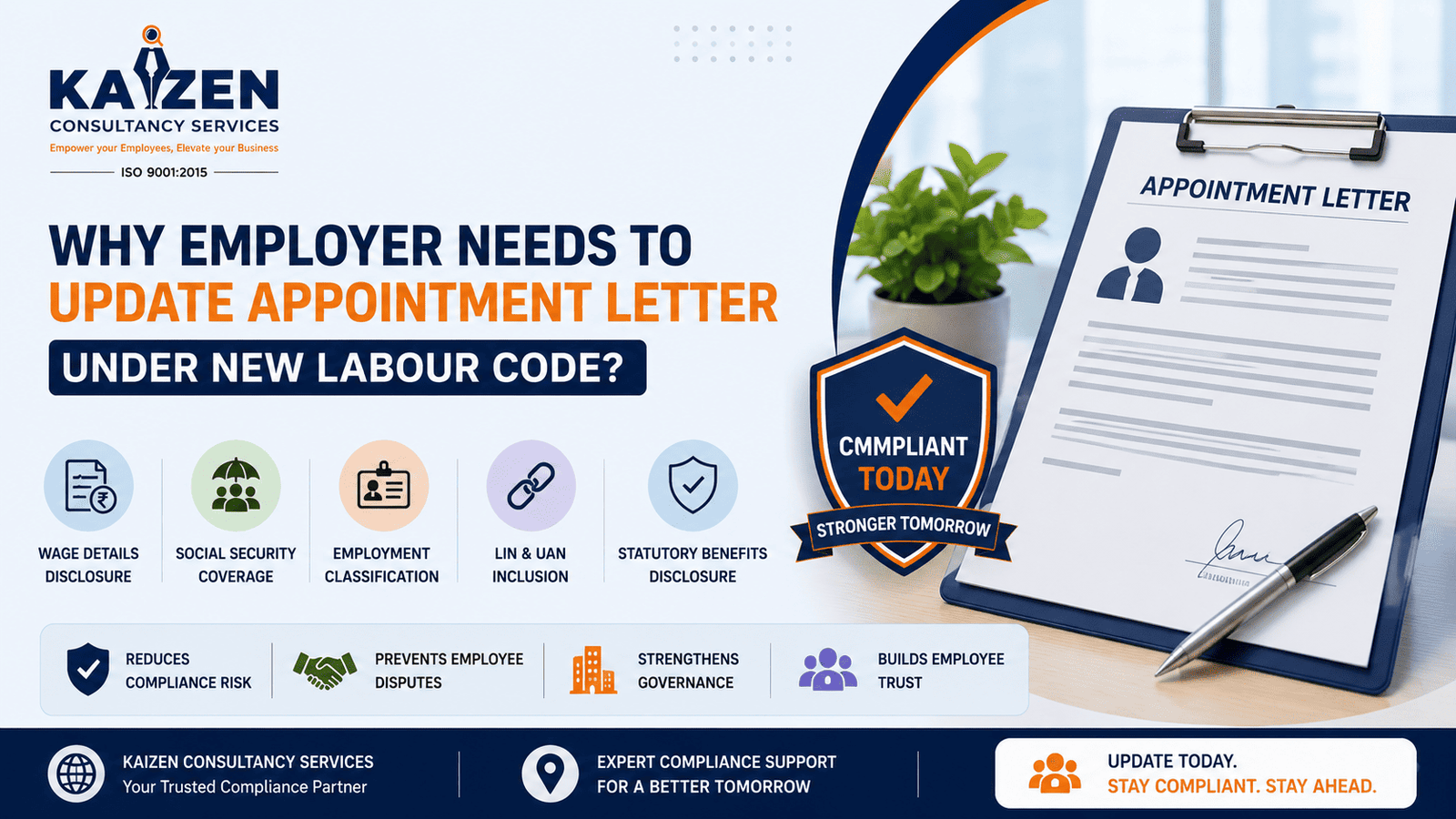
New Labour Code 2026
Why Every Employer Must Update Their Appointment Letter Immediately
India's labour law framework is undergoing a historic transformation through the implementation of the Labour Codes. One of the most significant changes for employers, HR professionals, and business owners is the increased emphasis on transparent employment documentation and standardised appointment letters.
Under the Code on Wages, 2019 and related Labour Codes, employers are expected to maintain clear employment records and provide employees with comprehensive appointment letters containing prescribed information.
For organizations that continue to use outdated appointment letter formats, the risk of non-compliance, employee disputes, and labour litigation is increasing.
This article explains the key provisions, mandatory appointment letter requirements, and practical compliance steps every HR professional and business owner should implement.
New Labour Code
APPOINTMENT LETTER as per New Labour code Rule
- Name of employee:
- Date of Birth:
Father’s Name:
- Aadhaar Number & Pan Number:
- Labour Identification Number of the establishment:
- Universal Account Number and / or Insurance Number ESIC IP:
Designation:
- Type of Employment (Regular / Fixed-term employment / Contractual):
- Category of skill:
- Date of Joining:
- Wages/Basic/Pay and Dearness allowance:
- Other allowances including accommodation whichever is/are applicable:
- Applicability of social security benefits (PF and ESIC):
- Board Nature of duties to be performed:
Benefits available under Chapter VI (Maternity Benefit) of the code on Social Security, 2020 (36 of 2020) (In Case of women employee):
Understanding the New Wage Code
The Code on Wages, 2019 consolidates and replaces four major wage-related legislations:
- Payment of Wages Act, 1936
- Minimum Wages Act, 1948
- Payment of Bonus Act, 1965
- Equal Remuneration Act, 1976
The objective of the Code is to:- Ensure uniform wage definitions
- Improve wage transparency
- Protect employee rights
- Standardize employment documentation
- Reduce legal disputes
- Simplify compliance requirements
The Code applies to employees across organized and unorganized sectors, subject to applicable rules and notifications.
Key Changes HR and Employers Must Implement
- Standard Definition of Wages
The Labour Codes introduce a common definition of wages across labour legislations.
This impacts:
- Provident Fund calculations
- Bonus calculations
- Gratuity calculations
- Overtime payments
- Salary structuring
Employers must review salary structures to ensure compliance with the prescribed wage definition.
- Greater Transparency in Employment Terms
Employers are expected to provide employees with clear written terms covering:
- Designation
- Employment category
- Salary structure
- Social security benefits
- Nature of duties
- Applicable benefits
Transparent documentation reduces future disputes and legal complications.
- Mandatory Employee Information
The appointment letter should contain complete employee identification and employment particulars.
Organizations should ensure proper documentation at the time of joining itself.
- Social Security Integration
Employers must capture information relating to:
- EPF membership
- ESIC membership
- UAN details
- Labour Identification Number (LIN)
This facilitates smooth compliance under the labour law ecosystem.
Need of Revision of Appointment letter - New Labour Code
An appointment letter is no longer merely an employment formality.
It serves as:
- Legal proof of employment
- Evidence of agreed terms and conditions
- Wage compliance record
- Social security compliance document
- Protection against labour disputes
- Proof during inspections and audits
A properly drafted appointment letter helps organizations demonstrate compliance with labour laws and reduces the risk of penalties.

Essential Clauses in the New Appointment Letter Format
HR professionals should ensure that the following details are incorporated in every appointment letter:
Employee Particulars
- Name of Employee
The full legal name of the employee as per official records.
- Date of Birth
Essential for age verification and statutory compliance.
- Father's / Mother's Name
Important for employee identification records and nominee too.
- Aadhaar Number
May be obtained after obtaining appropriate employee consent and in accordance with applicable legal requirements.
Establishment Information
- Labour Identification Number (LIN)
The Labour Identification Number allotted to the establishment.
This improves transparency and assists during labour inspections and compliance audits.
Social Security Details
- Universal Account Number (UAN)
Where available, the employee's EPF Universal Account Number should be recorded.
- ESIC Insurance Number (IP Number)
Applicable where the employee is covered under ESIC provisions.
- Applicability of Social Security Benefits
The appointment letter should clearly specify:
- EPF applicability
- ESIC applicability
- Other statutory benefits
Employment Details
- Designation
Clearly define the employee's position.
- Type of Employment
The category should be specifically mentioned:
- Regular Employment
- Fixed-Term Employment
- Contractual Employment
This is crucial from a legal and compliance perspective.
- Category of Skill
Mention whether the employee falls under:
- Highly Skilled
- Skilled
- Semi-Skilled
- Unskilled
This assists in determining applicable wage rates and statutory obligations.
- Date of Joining
The effective commencement date of employment.
Wage Details
- Basic Wage / Pay and Dearness Allowance
The appointment letter should clearly state:
- Basic Pay
- Dearness Allowance (if applicable)
These components are critical under the wage definition prescribed by the Code.
- Other Allowances
All allowances should be clearly disclosed, including:
- House Rent Allowance
- Conveyance Allowance
- Special Allowance
- Accommodation Benefits
- Other applicable benefits
Transparency in salary structure helps prevent future disputes.
Job Responsibilities
- Broad Nature of Duties
The employee's primary responsibilities should be described.
This helps define expectations and establish accountability.
Maternity Benefits
- Benefits Under Chapter VI of the Code on Social Security, 2020
For women employees, the appointment letter should mention entitlement to maternity benefits as applicable under law.
This reflects the organisation's commitment to statutory compliance and employee welfare.
Benefits of the New Appointment Letter Format for Employers
Reduced Legal Risk
Clear employment terms reduce the likelihood of labour disputes.
Improved Compliance
Organizations can demonstrate adherence to Labour Codes during inspections.
Better Documentation
A standardized format improves HR record management.
Stronger Employer Defence
Documented employment conditions provide legal protection during litigation.
Easier Payroll Administration
Clearly defined wage components improve payroll accuracy.
Benefits for Employees
Greater Transparency
Employees understand their employment terms from day one.
Social Security Awareness
Employees are informed about PF and ESIC benefits.
Protection of Rights
Written employment terms reduce ambiguity.
Improved Trust
Transparent documentation strengthens employer-employee relationships.
HR Compliance Checklist Under the New Wage Code
Before issuing an appointment letter, verify:
✓ Employee Name
✓ Date of Birth
✓ Father's/Mother's Name
✓ Aadhaar Details (with consent)
✓ Labour Identification Number (LIN)
✓ UAN Number
✓ ESIC IP Number
✓ Designation
✓ Employment Type
✓ Skill Category
✓ Date of Joining
✓ Basic Wage and DA
✓ Other Allowances
✓ Social Security Coverage
✓ Nature of Duties
✓ Maternity Benefit Clause (for women employees)
✓ Company Policies Reference
✓ Employee Acceptance and Signature
Frequently Asked Questions
Is an appointment letter mandatory under the Labour Codes?
Yes. Employers are expected to provide written employment terms to employees. A comprehensive appointment letter is considered a best practice and an important compliance document.
What is LIN in an appointment letter?
LIN stands for Labour Identification Number, a unique number assigned to establishments for labour law compliance purposes.
Should UAN be mentioned in the appointment letter?
Where available, recording the employee’s UAN helps maintain proper statutory records.
Is Aadhaar mandatory in an appointment letter?
Aadhaar details should be collected only after obtaining appropriate employee consent and in accordance with applicable legal requirements.
Why should employers revise old appointment letter formats?
Older formats may not adequately address Labour Code requirements, social security provisions, employment categories, and wage transparency obligations.
What is the benefit of mentioning employment type?
Specifying whether employment is regular, fixed-term, or contractual reduces ambiguity and helps ensure legal compliance.
Conclusion
The New Wage Code and Labour Codes are reshaping employment compliance across India. Employers who continue using outdated appointment letters may expose themselves to unnecessary compliance risks and employee disputes.
A modern appointment letter incorporating wage details, social security coverage, employment classification, LIN, UAN, ESIC particulars, and statutory benefit disclosures helps organizations achieve stronger compliance, better governance, and enhanced employee trust.
Business owners and HR professionals should proactively review and update their appointment letter formats to align with emerging Labour Code requirements and establish a robust compliance framework for the future.
Business owners and HR professionals should proactively review and update their appointment letter formats to align with emerging Labour Code requirements and establish a robust compliance framework for the future.